
Taming Snowflake Clusters: A Platform Engineer's Guide to Edge Kubernetes Fleets
Each one was built individually, over years, by whoever happened to be on-site at the time—unique configurations, undocumented patches, and no two clusters quite alike. Multiply that by dozens or hundreds of retail stores, factory floors, or remote sites, and you've got an operational liability, not an edge strategy.
This isn't a hypothetical for most organizations running Kubernetes at scale—it's the default outcome of edge deployments that grew organically. Nobody sets out to build 200 inconsistent clusters. It happens one urgent site rollout at a time, over several years, with different engineers, different tooling versions, and different shortcuts taken under different deadlines.
By the time someone asks to standardize the fleet, the sprawl has already become the baseline. The answer isn't simply another automation script. Platform teams need to approach edge Kubernetes as a fleet-management problem from day one.
1. Why Edge Kubernetes Requires a Different Playbook
The core insight worth internalizing is that edge is less a location than an operating condition.
It's not about distance from a data center—it's about the constraints that come with it: unreliable connectivity, no on-site platform engineer to SSH in and fix things, and infrastructure that has to keep functioning when it's cut off from everything else.
A cluster running in a well-connected regional data center and a cluster running in a retail store with a single, occasionally flaky internet line are not the same engineering problem, even if they're running identical Kubernetes versions.
That operating condition creates three recurring problems for teams managing clusters at scale:
Lifecycle Standardization
Clusters get hand-provisioned differently at each site, so "upgrade the fleet" becomes dozens of one-off upgrades instead of one action. Every deviation—a slightly different node size, a manually applied patch, or a configuration drift nobody documented—turns a routine upgrade into a site-by-site investigation.
Configuration Synchronization
Pushing configuration changes reliably to sites with intermittent connectivity is fundamentally different from updating a cluster that's always reachable. A push-based deployment model that assumes the target is always listening can silently fail, partially apply, or leave a site out of sync—and often nobody notices until something breaks.
Observability at Scale
The dashboards built for monitoring a single cluster fall apart when you're trying to see the health of hundreds at once. A per-cluster Grafana instance that works fine for one environment becomes unusable noise across a fleet. You need aggregation, not just replication, of the same tooling.
2. The Fleet-First Toolkit
The fix isn't a better script—it's treating the constraints as first-class design inputs and provisioning edge environments to work with those constraints rather than around them.
Cluster API (CAPI)
Cluster API (CAPI) replaces hand-crafted Terraform-and-Ansible provisioning with declarative, standardized cluster lifecycle management. Instead of scripting each cluster's creation, you describe the desired state and let CAPI reconcile toward it—the same declarative model Kubernetes itself uses, applied one layer up, to the clusters themselves rather than just the workloads running on them.
This matters at the edge specifically because it makes "provisioning cluster #201 identically to the other 200" a template operation instead of a bespoke project. This is also the same declarative automation mindset engineers develop through hands-on AWS DevOps training and DevOps engineering programs.
GitOps
GitOps tools such as FluxCD and ArgoCD turn a Git repository into the single source of truth for every cluster in the fleet.
This approach solves a major connectivity problem: pull-based reconciliation means each site's agent checks in and applies changes when it can, rather than waiting for a central system to successfully push to it.
A site going offline for a day doesn't halt progress. The local agent continues operating from cached local state and catches up and reconciles once connectivity returns.
This inversion—from "push and hope it lands" to "pull whenever you're able"—is arguably the single most important architectural shift for edge fleets because it is designed around the assumption that the network can't always be trusted.
Golden Images
Golden images replace hand-patching individual clusters with versioned, pre-tested, immutable images. If a cluster needs to be rebuilt, it's rebuilt from a known-good image rather than patched into an unknown state.
That means your recovery process is the same tested path every time, not an improvisation under pressure at 2 a.m. when a site is down.
Immutability does double duty: it reduces operational risk during normal upgrades and makes disaster recovery a rehearsed procedure instead of a novel one.
Policy as Code
Centralized policy-as-code enforcement—CIS Benchmark hardening, FIPS 140-2 support where required, and tools such as Gatekeeper—applies one consistent security and compliance posture across every cluster instead of relying on each site to independently get it right.
This is particularly important at the edge, where the absence of an on-site security engineer means policy has to be enforced by the platform itself, not by a person double-checking configuration.
Fleet-Wide Observability
Fleet-wide observability, increasingly with AI-assisted anomaly detection layered on top, gives teams a single pane that flags issues proactively rather than requiring someone to notice a problem cluster-by-cluster.
At fleet scale, the goal shifts from "Can I see this cluster's metrics?" to "Can the system tell me which of my 200 clusters needs attention right now, without me having to check all 200?"
Notably, CNCF reports that 66% of organizations are now running generative AI workloads on Kubernetes—which means the fleets platform teams are standardizing today are also the ones that will need to support AI/ML workloads at the edge tomorrow, from local inference to data preprocessing pipelines that can't tolerate round-tripping to a central cloud.
Getting the fleet model right now pays off twice: once in reduced operational overhead today, and again when those clusters need to absorb a new class of workload without a redesign.
3. What "Air-Gapped" Actually Requires
One detail worth calling out specifically: genuinely air-gapped edge deployments—sites with no internet dependency at all—push every one of the practices above further than most teams initially expect.
Golden images can't be pulled from a remote registry at deploy time; they need to be baked in or delivered by physical or local means.
GitOps reconciliation has to tolerate not just intermittent connectivity but permanent disconnection, relying entirely on cached state and local automation.
Policy enforcement has to run fully locally, since there's no central gatekeeper instance to phone home to for a decision.
Designing for "usually connected, sometimes offline" and designing for "never connected" are different exercises, and it's worth being explicit about which one your fleet actually needs before committing to an architecture.
4. The Technology Is Only Part of the Problem
The tooling matters, but it's not the whole story: the edge Kubernetes problem is as much a people and process problem as it is a technical one.
Standardizing infrastructure doesn't help much if the team managing it is still organized around treating each site as a special case. An on-call rotation built around "whoever set up that cluster originally" doesn't scale, no matter how solid their Linux administration skills are.
Moving to a fleet model usually requires a parallel shift in team structure: from site-specific ownership to platform-wide ownership, with runbooks and automation that work the same way regardless of which site triggered the alert.
The real payoff of fleet-first tooling is what it frees teams up to do instead. It should give teams back the bandwidth to focus on engineering improvements rather than constantly fighting fires at individual sites.
That's not just a productivity win; it's often the difference between a platform team that can take on new initiatives and one that's permanently consumed by keeping the existing sprawl alive.
5. A Practical Migration Path for Existing Snowflake Fleets
For teams starting from an already-sprawling fleet rather than a greenfield deployment, the path usually looks less like a rip-and-replace and more like gradual convergence.
- Choose a golden image: Start with the best-understood current configuration and turn it into a versioned baseline.
- Pilot GitOps: Stand up GitOps tooling and point it at a small group of representative clusters.
- Standardize new clusters: Use Cluster API to bring newly created or rebuilt clusters into compliance with the standard.
- Converge existing clusters: Bring older clusters into the standard when they naturally come up for renewal, hardware refresh, or major maintenance.
- Measure fleet health: Introduce centralized metrics, logs, dashboards, and fleet-aware alerting.
- Automate policy enforcement: Move security and compliance requirements into policy-as-code.
Trying to force every existing snowflake into compliance simultaneously tends to generate more incidents than it prevents. Converging opportunistically, cluster by cluster, as each one is touched anyway, is usually the more sustainable route.
6. Choosing a GitOps Tool for Fleet-Scale Kubernetes
Teams new to GitOps often get stuck comparing FluxCD and ArgoCD feature by feature when the more useful question for a fleet specifically is how each handles scale and multi-cluster management out of the box.
ArgoCD
ArgoCD's UI-driven, application-centric model tends to shine when teams want strong visibility into what's deployed where, with a central dashboard operators actually look at day-to-day.
This can be particularly useful when a fleet is small enough that a human is still routinely reviewing deployment state.
FluxCD
FluxCD's more Kubernetes-native, controller-based approach tends to scale cleanly to large fleets managed almost entirely through Git and automation, with less reliance on a central UI as the source of operational truth.
Neither is strictly better. The right choice tracks how much of your fleet's day-to-day operation you expect a person to be watching versus how much you expect to be fully automated.
Many organizations running large edge fleets end up leaning toward the more automation-first end of that spectrum, particularly as the fleet outgrows what a human can meaningfully review cluster by cluster.
7. What Fleet-Scale Observability Really Requires
It's worth being specific about what "fleet-wide observability" means in practice, because the phrase can mean very different things depending on maturity.
Level 1: Centralized Metrics and Logs
At the most basic level, it means aggregating metrics and logs from every cluster into a single backend rather than maintaining separate dashboards per site.
This is table stakes, but it is still missing at plenty of organizations that are in the middle of a fleet migration.
Level 2: Fleet-Aware Alerting
The next level is alerting that's fleet-aware rather than cluster-aware. Instead of 200 separate alert rules that each fire independently, a rule might say "alert if more than 5% of the fleet shows this symptom."
This surfaces systemic issues such as a bad rollout or a shared dependency failure without drowning the team in per-site noise from isolated, expected failures.
Level 3: Anomaly Detection
The most mature version layers anomaly detection on top, flagging a cluster that's behaving differently from its peers even when no explicit threshold has been crossed.
This can catch the "this one site is quietly degrading" case that static thresholds tend to miss entirely.
Most teams don't need to start at the most mature version. The meaningful jump is usually getting from "no fleet-wide view" to "one dashboard, fleet-aware alerting." The anomaly detection layer is worth adding once that foundation is solid, not before.
8. Where to Build This Skill Set
Fleet-first Kubernetes management—CAPI, GitOps pipelines, policy-as-code, and the cloud platforms these fleets typically run alongside—is precisely the kind of hands-on, project-based skill that's hard to pick up from documentation alone.
For engineers looking to build practical DevOps and cloud infrastructure skills, Innovative Academy's DevOps and cloud training programs provide a pathway into technologies used across modern infrastructure environments.
Innovative Academy's Bengaluru-based DevOps Engineering Bootcamp is designed around hands-on learning and real-time industry projects rather than lecture-only instruction. It can be particularly relevant for engineers targeting DevOps, cloud, platform engineering, and infrastructure roles.
Engineers targeting AWS-centric infrastructure can also explore AWS DevOps Engineering Training, while those planning to work with Microsoft's cloud ecosystem can explore the institute's Azure training programs.
For learners building a broader infrastructure foundation, exploring Innovative Academy's networking and cloud computing courses can help connect networking fundamentals with Linux, cloud, automation, and DevOps practices.
The combination of hands-on projects, resume building, interview preparation, and placement support can help aspiring engineers prepare for the practical expectations of modern IT infrastructure roles.
Final Thoughts
Snowflake Kubernetes clusters are rarely created because an organization deliberately chose inconsistency. They are usually the result of years of organic growth, local fixes, changing engineers, changing tooling, and urgent deployments.
The solution is not simply to make every engineer follow a larger checklist. The better approach is to redesign the platform so that consistency becomes the default.
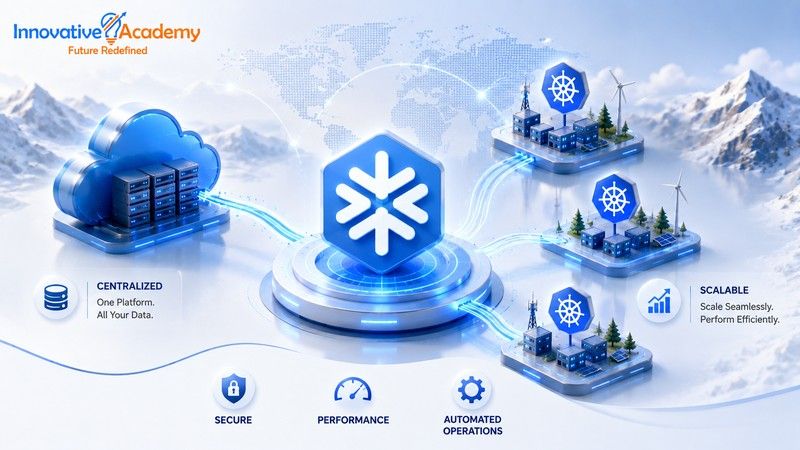
Cluster API provides declarative lifecycle management. GitOps provides a reliable reconciliation model for unreliable networks. Golden images provide repeatable infrastructure. Policy-as-code provides consistent security controls. Fleet-wide observability provides the visibility needed to manage hundreds of clusters without manually inspecting every site.
Most importantly, the fleet-first mindset changes the question from "How do we fix this cluster?" to "How do we make sure this entire class of problems is handled automatically across the fleet?"
That's the shift platform engineering teams need to make if edge Kubernetes is going to remain manageable as the number of sites—and the workloads running on them—continues to grow.