
Samsung's Next-Gen Memory Just Cleared a Big Technical Hurdle — Here's What It Does and Doesn't Prove
1. Introduction
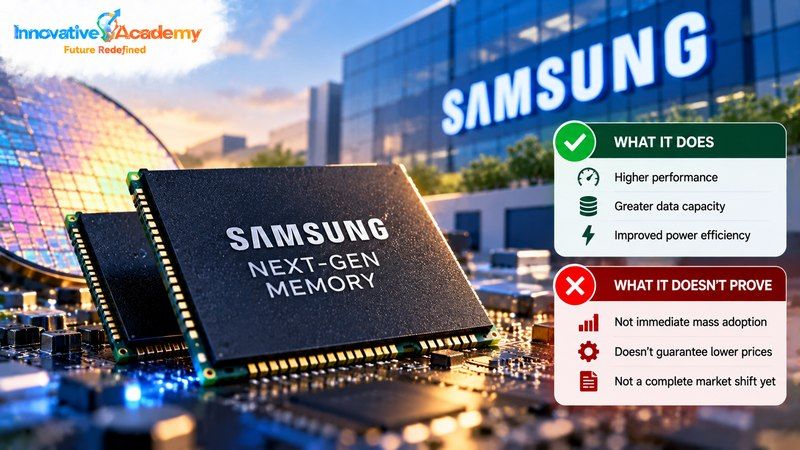
Samsung's Memory Business Division has reportedly completed qualification of its 12-layer HBM4E memory, news that surfaced through the Korean outlet Hankyung around October 7, 2026. Qualification is a genuinely significant engineering milestone, and it's also easy to overstate in a headline. Worth working through exactly what passing this specific test does, and doesn't, actually confirm.
2. What Actually Got Qualified, and by Whom
Samsung's own Memory Business Division is reported to have completed the qualification process for its 12-layer HBM4E chip, with the news coming from Hankyung rather than a direct Samsung announcement. Samsung has not publicly named which customer's qualification process this refers to, customer relationships at this level are kept private as a matter of course, though Nvidia and other major hyperscalers are widely considered the likely parties, given who actually buys AI memory at this tier in the first place.
3. HBM4 and HBM4E Are Not the Same Chip — Keep Them Separate
These two names look like a minor version bump, and treating them that way is the easiest way to misread this entire story. Samsung began mass-producing HBM4, the base generation, back in February 2026. HBM4E is a distinct, more advanced successor, and the chip that just finished qualification is specifically the 12-layer HBM4E part, not HBM4 itself. Samsung first shipped 12-layer HBM4E samples to customers on May 29, 2026, an industry first at the time, and what happened in early October is a different, later milestone: those samples clearing the formal qualification process, not the initial sampling step.
4. What Makes HBM4E Specifically Faster
Samsung's 12-layer HBM4E stacks 48GB of capacity and runs at up to 16 gigabits per pin, which the May sampling round had already demonstrated translates to roughly 3.6 terabytes per second of bandwidth per stack. Samsung is also claiming a 16% gain in energy efficiency over the prior generation, achieved through a combination of a 1c-class DRAM process and a 4-nanometer logic die built at Samsung's own foundry. That efficiency figure matters as much as the raw speed number does, since AI data centers are increasingly constrained by power and cooling budgets as much as by raw chip performance.
5. The Rival Racing the Same Milestone
Samsung isn't the only company chasing this specific qualification, and it may not even be ahead. SK Hynix's own competing HBM4E part is rated at 4.0 terabytes per second, a 38% gain over HBM4 by SK Hynix's own measurement, and the company has reportedly moved its HBM4E sampling target up to June or July of 2026, earlier than originally planned. News of that accelerated timeline reportedly pushed SK Hynix's stock up roughly 7%, a reminder that in this market, hitting these milestones early carries real, immediate financial weight for whichever company gets there first.
6. Where HBM4E Actually Plugs In, and Why the Timing Matters
This is the part of the story that most benefits from slowing down rather than reading the headline as "Samsung just landed the Nvidia deal." Nvidia's current Rubin platform uses HBM4, the base generation, not HBM4E, and SK Hynix reportedly holds roughly two-thirds of that specific allocation according to TrendForce. HBM4E, the chip that just cleared qualification, is earmarked instead for Rubin Ultra, a future platform that isn't expected to begin ramping until late 2027. Put plainly: this qualification milestone is real, but the product it's actually built for is still more than a year away from shipping in volume, which is why one industry analysis described the news as mainly a signal to investors about where Samsung stands competitively, rather than a confirmed production commitment with revenue attached today.
7. A Separate HBM4 Story, Not the Same as This One
Worth untangling a second, entirely different thread in this space so it doesn't get folded into the HBM4E story above: separate reporting indicates SK Hynix has committed most of its 2026 HBM4 output specifically to Nvidia, a decision that leaves Samsung positioned as AMD's primary HBM4 supplier for the Instinct MI455X accelerator. That's an HBM4 allocation story, about the current generation feeding a different customer and a different chip, and it has nothing directly to do with the HBM4E qualification milestone described above. Both stories involve Samsung, both involve AI memory, and both happened in roughly the same window, which is exactly why it's easy to accidentally merge them into one narrative that isn't accurate for either.
8. Who Actually Leads HBM Revenue Today
Pulling back to the broader market, Q3 2025 figures put SK Hynix at 57% of total HBM revenue, with Samsung at 22% and Micron at 21%. Worth flagging the limits of that comparison honestly: this is total HBM revenue across the market broadly, not a breakdown specific to Rubin or Rubin Ultra allocations, so it's a useful snapshot of overall market position rather than direct evidence about who wins any one specific future contract, including the HBM4E-to-Rubin-Ultra story above.
9. Why Memory Bandwidth Is Worth Understanding Even Outside a Fab
None of this requires working inside a Samsung or SK Hynix cleanroom to actually matter. Every large AI model running inference or training at scale is fundamentally bottlenecked by how fast data can move between memory and the processor actually doing the computing, which is exactly what metrics like terabytes-per-second of bandwidth are measuring in the first place. Anyone building, deploying, or simply troubleshooting hardware that touches AI workloads benefits from understanding that a chip's advertised compute speed means comparatively little if the memory feeding it can't keep pace, which is precisely the constraint each new HBM generation is built to push back against.
10. Building the Hardware Fundamentals at Innovative Academy
Innovative Academy's Hardware & Networking program in Bangalore builds the foundational understanding of how memory, processors, and system architecture actually interact, the same underlying concepts that explain why a bandwidth jump from 3.6 to 4.0 terabytes per second is treated as genuinely significant news in a market moving this fast.
11. FAQs
1. Did Samsung just confirm a supply deal with Nvidia for this chip?
Not confirmed publicly. Samsung hasn't named the customer that completed qualification, though Nvidia and other hyperscalers are widely considered likely candidates. Qualification is a technical milestone, not a disclosed commercial contract.
2. Is HBM4E just a faster version of HBM4?
It's a distinct, later generation. Samsung was already mass-producing HBM4 as of February 2026 before HBM4E samples shipped in May 2026 and then cleared qualification in October.
3. Does this mean Samsung's HBM4E is going into Nvidia's current Rubin chips?
No. Rubin uses HBM4, with SK Hynix holding roughly two-thirds of that allocation. HBM4E is earmarked for Rubin Ultra, which isn't expected to ramp until late 2027.
4. Is Samsung ahead of SK Hynix on HBM4E?
Not clearly. SK Hynix's HBM4E is rated at a higher 4.0 terabytes per second against Samsung's 3.6, and SK Hynix has also moved its own sampling timeline earlier, so this reads more as a close competitive race than a Samsung lead.
5. Does Samsung make HBM4 for any major AI chipmaker right now?
Yes, separately from the HBM4E story, Samsung is reported to be AMD's primary HBM4 supplier for the Instinct MI455X, after SK Hynix committed most of its own 2026 HBM4 output to Nvidia.
12. Final Thoughts
The accurate way to read this news is as a genuine technical win for Samsung, clearing qualification on a demanding next-generation memory chip, sitting well ahead of the product it's actually destined for. Rubin Ultra's late-2027 ramp means this is a milestone worth tracking for where the competitive race currently stands, not evidence of a production deal already locked in, and keeping HBM4E's story separate from the current HBM4-Rubin and HBM4-MI455X allocation stories is the difference between understanding this market and just reacting to whichever headline uses the word "qualified."
If you want to build the hardware fundamentals behind stories like this one, explore the Hardware & Networking Course in Bangalore at Innovative Academy. Contact for course details: 8447712333.