
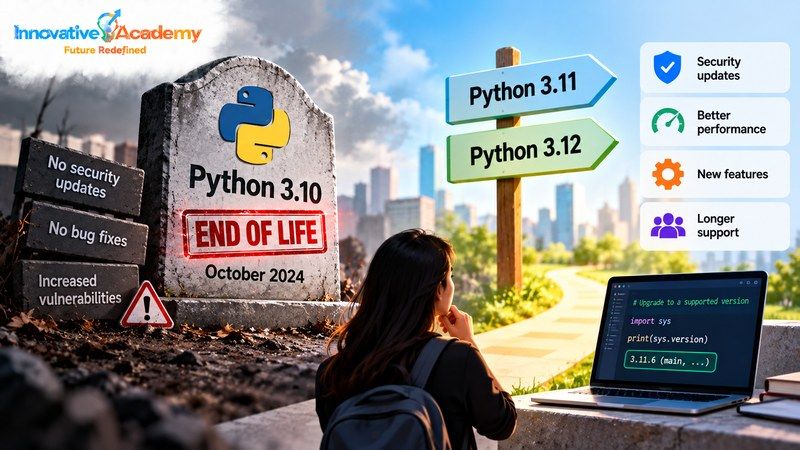

Python 3.10 Just Reached End of Life — Here's What That Actually Means for Your Code
1. Introduction
Five Python release branches got patched on October 1, 2026, and one of them got something different: a final release, after which nobody will ever patch it again. Python 3.10 is now officially end-of-life, and if that phrase means nothing concrete to you yet, it's worth understanding exactly what changes the moment a widely-used language version crosses that line.
2. What Actually Happened on October 1
The Python core team shipped five releases on October 1, 2026: 3.10.22, 3.11.17, 3.12.15, 3.13.16, and 3.14.8. Four of those are routine maintenance, bug fixes and security patches for branches that are still actively supported. The fifth, 3.10.22, is different in kind rather than degree: it's the last release the 3.10 branch will ever receive, full stop, closing out a line that first shipped five years earlier.
3. The Full Five-Year Story, From PEP 619
Python's own release-schedule document, PEP 619, lays out the whole arc plainly. Development on 3.10 began May 18, 2020, and 3.10.0 itself shipped October 4, 2021. For about a year and a half, it received regular bugfix releases with full binary installers, ending with 3.10.11 on April 5, 2023. From 3.10.12 onward, starting June 6, 2023, it moved into security-only mode, source-code patches issued irregularly, only as actual vulnerabilities turned up, with no new installers. That lasted another three-plus years until October 1, 2026, five years to the month after 3.10.0's original release, when 3.10.22 shipped as what PEP 619 itself calls the final security release, and the branch's source tree is now frozen for good.
4. What "End of Life" Actually Means, Precisely
It's worth being exact about this rather than treating "end of life" as a vague warning label. It does not mean Python 3.10 stops running, code written for it will keep executing exactly as it did the day before. What it means is narrower and more specific: no one on the Python core team will ever again issue a fix for a security vulnerability discovered in 3.10 from this point forward, however serious. If a flaw is found in the interpreter, the standard library, or anywhere else in that codebase next month, next year, or five years from now, 3.10 simply stays vulnerable, permanently, because the branch that would have received the patch no longer exists in any maintained form.
5. What Shipped in the Final Release Itself
Even in the process of closing the branch out, 3.10.22 carried real, substantive fixes, worth knowing specifically because they illustrate exactly the kind of protection that now stops arriving. The release hardened handling inside the tarfile and zipfile modules, fixed a TLS hostname validation issue, bundled an updated OpenSSL (3.5.9), and patched an issue the release notes describe as closing off a credential-leak path. That's a genuinely meaningful cluster of security-relevant fixes for a "final" release, and it's a useful illustration of the kind of patch that 3.10 will simply never receive again if something comparable turns up next.
6. Why This Matters Even If Nobody Forces You to Upgrade
There's no mechanism that stops a 3.10 interpreter from running tomorrow, next month, or next year, which is exactly what makes this the kind of deadline that's easy to quietly ignore until it actually costs something. The risk isn't instant, it's compounding: every month that passes after October 1, 2026 is a month where a newly discovered vulnerability in 3.10 has no official fix coming, on an interpreter that may still be sitting in production handling real traffic, real data, or real infrastructure. Treating an EOL date as optional because nothing immediately breaks is exactly the gap that turns into an actual incident later, usually at a worse time than when the upgrade would have been straightforward.
7. Where to Actually Move To
The practical target depends on how recent you want to land. Python 3.14, which received its own patch (3.14.8) in this same release round, is the current actively developed branch and the furthest from its own eventual end-of-life date. Python 3.13 and 3.12 are both still in active bugfix or security support and represent a smaller jump from 3.10 if a full migration to the newest release isn't realistic immediately. What matters most isn't landing on the single newest version, it's landing on anything still inside an actively maintained window, since that's the entire difference this whole story is actually about.
8. How to Check What You're Actually Running, and What Depends on It
Before migrating anything, the honestly useful first step is an inventory, not a guess: run python3 --version across every server, container image, and CI pipeline actually in use, rather than assuming based on when a project was originally set up. Check requirements.txt or a lockfile for dependencies that might themselves only support older Python versions, since a dependency pinned to something 3.10-specific can turn what looks like a simple interpreter bump into a chain of smaller upgrades first. A version that quietly slipped out of support is far more common in real codebases than teams expect, specifically because nothing visibly breaks on the day it happens.
9. Learning Python on a Version That Still Has a Future at Innovative Academy
Innovative Academy's Python program in Bangalore teaches against whichever Python release is actually current and actively maintained, not a version that's already drifted into its own countdown, so what gets learned in the classroom is the same version worth actually deploying afterward, not something that needs relearning the moment a real job expects current practice.
10. FAQs
1. Will my existing Python 3.10 code stop running after October 1, 2026?
No. End-of-life doesn't disable anything, code already written and deployed on 3.10 keeps executing exactly as before. What stops is future security patches for any new vulnerability discovered in that branch from now on.
2. Is this the first time Python 3.10 has changed status?
No, it's actually the third phase. It had full bugfix support with installers through April 2023, then moved to security-only patches (source releases only, issued as needed) from June 2023 until this final release on October 1, 2026.
3. Which Python version should I actually move to?
Python 3.14 is the current actively developed branch and furthest from its own end-of-life date. 3.12 and 3.13 are both still actively supported and represent a smaller step if jumping straight to 3.14 isn't practical right away.
4. What specifically got fixed in the final 3.10.22 release?
Hardened tarfile and zipfile handling, a TLS hostname validation fix, a bundled OpenSSL update to 3.5.9, and a fix closing a credential-leak issue, a genuinely substantive set of security fixes for what turned out to be the branch's last release.
5. How do I find out if I'm still running 3.10 somewhere without realizing it?
Run python3 --version across every server, container image, and CI/CD pipeline actually in use rather than relying on memory of when something was set up, and check dependency files for anything pinned to a 3.10-specific requirement before assuming the upgrade will be a simple one-line change.
11. Final Thoughts
Python 3.10's end-of-life date isn't a dramatic event, nothing visibly changes on October 1, which is exactly why it's the kind of deadline that quietly becomes a real problem months later rather than immediately. The five-year arc from release to bugfix support to security-only mode to this final patch is Python's own documented, predictable process, PEP 619 spelled it out from the start, which means the right response isn't surprise, it's simply checking what's actually still running on 3.10 and moving it before an unpatched vulnerability becomes the thing that forces the question.
If you want to learn Python on a current, supported release, explore Python Training in Bangalore at Innovative Academy. Contact for course details: 8447712333.