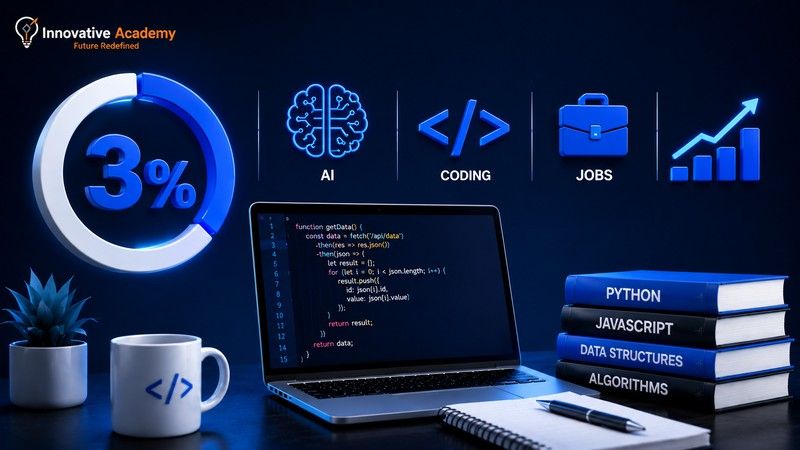

Only 3% of US Workers Lost Jobs to AI Since 2023 — What This Means If You're Learning to Code in 2026
Table of Contents
- 1. Is AI Really Eliminating Programming Jobs?
- 2. Why the "3%" Number Can Be Misleading
- 3. The Real Problem: Entry-Level Tech Jobs
- 4. AI Is Changing What Programmers Do
- 5. Should You Still Learn Coding in 2026?
- 6. The New Skills Every Developer Needs
- 7. Coding + AI Is More Valuable Than Coding Alone
- 8. What Should Students Learn?
- 9. A Practical 2026 Coding Roadmap
- 10. The Future Belongs to AI-Augmented Developers
- 11. Learn It the Right Way — With Innovative Academy
- 12. Final Thoughts
Artificial intelligence has changed how we think about technology careers. Since ChatGPT and other generative AI tools became mainstream, students learning programming have increasingly asked the same question: "If AI can write code, is learning to code still worth it?"
The short answer is yes — but the definition of being a programmer is changing.
Recent labor-market research does not show evidence of AI causing widespread job losses across the entire U.S. economy. Stanford researchers analyzing ADP payroll data through June 2026 found no evidence of economy-wide displacement. However, they also found that workers aged 22–25 in highly AI-exposed occupations were employed at levels about 19% below what would have been expected relative to less-exposed occupations.
That distinction is critical for anyone learning to code in 2026.
The biggest risk may not be that AI eliminates programming jobs overnight. The bigger risk is that companies increasingly expect one developer to accomplish what previously required several people — with AI helping along the way.
So, if you're currently learning Python, Java, JavaScript, C++, or another programming language, what should you do?
Let's break it down.
1. Is AI Really Eliminating Programming Jobs?
The internet often presents AI and employment as a simple story:
AI becomes better → AI writes code → programmers lose their jobs.
Reality is much more complicated.
AI can already generate code, explain programming concepts, identify bugs, write tests, create documentation, and help developers move faster.
Coding is also one of the occupations where generative AI exposure is particularly high. Research from the Federal Reserve found that coder employment growth has slowed considerably since the introduction of ChatGPT, although aggregate coder employment has continued to grow.
That means the story isn't that "programming is dead."
It's closer to:
"Programming is becoming an AI-assisted profession."
And that is a very different thing.
2. Why the "3%" Number Can Be Misleading
The headline that only a small percentage of workers have lost jobs because of AI can sound reassuring.
But job displacement isn't the only way technology changes employment.
AI can affect the labor market through:
- Reduced hiring
- Smaller teams
- Higher productivity expectations
- Fewer entry-level opportunities
- Changes in job responsibilities
- Wage pressure
- New types of technical roles
- Increased demand for AI-related skills
Stanford's latest research is particularly interesting here. Researchers found no evidence of widespread economy-wide AI displacement, but they observed that younger workers in highly AI-exposed occupations are increasingly falling behind their peers in less-exposed occupations.
The adjustment appears to be happening primarily through reduced hiring of younger workers rather than increased separations.
This scenario changes the question for students.
Instead of asking:
"Will AI take my job?"
You should ask:
"Will I have the skills companies need when AI changes the job?"
3. The Real Problem: Entry-Level Tech Jobs
This may be one of the most important lessons for students learning technology in 2026.
AI doesn't necessarily need to replace an entire software engineer. It can automate individual tasks that traditionally helped junior developers gain experience.
For example, AI can increasingly help with:
- Basic code generation
- Simple debugging
- Boilerplate code
- Documentation
- Unit-test generation
- SQL queries
- Code conversion
- Basic API integrations
- Simple scripts
- Code explanations
These tasks have historically been part of the learning curve for junior developers.
As AI becomes better at handling them, companies may expect junior employees to arrive with stronger problem-solving abilities from day one.
Stanford's research supports this concern: the employment gap is concentrated among younger workers in highly AI-exposed occupations.
That doesn't mean beginners shouldn't enter technology — it means they need to prepare differently.
4. AI Is Changing What Programmers Do
Imagine two developers.
Developer A knows how to write basic Python, create simple applications, follow tutorials, copy code from AI, and fix errors using AI.
Developer B knows how to design an application, understand system architecture, write and review code, debug complex problems, work with databases, build APIs, use Git, deploy applications, test software, secure applications, and use AI coding tools effectively.
Who is more valuable?
Most likely, Developer B.
Why?
Because AI can generate code, but generating code isn't the same as understanding a complete software system.
A developer still needs to decide:
- What should be built?
- Why should it be built this way?
- Is the generated code correct?
- Is it secure?
- Will it scale?
- How should it be tested?
- How does it fit into the existing infrastructure?
Those are engineering questions, not prompting questions.
5. Should You Still Learn Coding in 2026?
Yes — but don't learn programming the way students learned it ten years ago.
The goal shouldn't simply be:
"I want to become someone who writes code."
The goal should be:
"I want to become someone who can use code, technology, and AI to solve real problems."
That distinction matters.
Programming remains the foundation for many areas of technology, including:
- Software development
- Web development
- Data engineering
- AI and machine learning
- Cloud computing
- DevOps
- Cybersecurity
- Automation
- Application development
- Infrastructure engineering
AI actually makes programming knowledge more useful in some situations because it gives developers a powerful assistant — but you need enough technical knowledge to control and evaluate that assistant.
If you're starting with Python, you can explore Python Development Training in Bangalore at Innovative Academy.
6. The New Skills Every Developer Needs
Learning a programming language is still important, but programming language knowledge alone isn't enough.
A strong 2026 developer should build skills across several layers.
Programming Fundamentals
Learn variables, data structures, functions, loops, object-oriented programming, algorithms, error handling, and debugging.
Don't skip the fundamentals just because AI can write code. They help you understand whether the AI-generated code is actually good.
Git and GitHub
Modern development requires collaboration. Learn Git, GitHub, branching, pull requests, merge conflicts, and code reviews.
Databases
Understand SQL, relational databases, NoSQL basics, database design, queries, and indexing.
APIs
Learn how applications communicate — REST APIs, HTTP, JSON, authentication, and API integration.
Cloud
Applications increasingly run on cloud infrastructure. Understanding platforms such as AWS or Azure can make a developer much more versatile.
Explore AWS DevOps Engineering Training to understand how cloud and DevOps skills can complement programming.
AI Tools
Don't avoid AI — learn how to use it.
AI can help developers with:
- Code generation
- Debugging
- Testing
- Documentation
- Refactoring
- Research
- Prototyping
Anthropic's research shows that coding remains one of the dominant uses of AI systems, highlighting how deeply AI tools are becoming integrated into software work.
7. Coding + AI Is More Valuable Than Coding Alone
Think about AI as a productivity multiplier.
A developer who understands programming can use AI to accelerate development.
A beginner who doesn't understand programming may simply copy whatever AI produces — and that's a major difference.
For example, suppose AI generates a 200-line Python application.
A knowledgeable developer can ask:
- Is the architecture correct?
- Are there security vulnerabilities?
- Are exceptions handled properly?
- Is the database query efficient?
- Can this scale?
- Is sensitive information exposed?
- What happens if the API fails?
Someone without programming fundamentals may not even know what questions to ask.
That's why AI literacy should complement programming education, not replace it.
8. What Should Students Learn?
If you're starting your technology journey in 2026, don't try to learn everything simultaneously — build your skills progressively.
Start with programming fundamentals, then Python or Java, then Git, then SQL.
From there, move into APIs, projects, cloud, and AI tools.
After that, choose a specialization.
Software Development
- Java / Python / JavaScript
- Data structures
- Databases
- APIs
- Git
- Cloud
- Testing
- AI-assisted development
AI & Machine Learning
- Python
- Mathematics fundamentals
- NumPy
- Pandas
- Machine learning
- Deep learning
- APIs
- Generative AI
- LLM applications
DevOps & Cloud
- Linux
- Git
- Docker
- Kubernetes
- CI/CD
- Terraform
- AWS / Azure
- Python or Bash
- AI-assisted automation
For students interested in this path, explore the DevOps Bootcamp Training in Bangalore.
Cybersecurity
- Networking
- Linux
- Python
- Security fundamentals
- Web security
- Cloud security
- Security tools
- AI-assisted security analysis
The important thing is that coding becomes part of a larger technical skill set.
9. A Practical 2026 Coding Roadmap
Months 1–2: Programming Fundamentals
Choose one language — Python is a good starting point.
Learn syntax, variables, functions, lists, dictionaries, classes, file handling, and exceptions, and build small projects along the way.
Don't spend two months just watching tutorials and not writing code.
Months 3–4: Real Development Skills
Learn Git, GitHub, SQL, APIs, JSON, basic web development, and debugging.
Build projects such as:
- Student management system
- Expense tracker
- Weather application
- REST API
Months 5–6: AI-Assisted Development
Now integrate AI into your workflow.
Use it to:
- Generate initial code
- Explain unfamiliar code
- Find bugs
- Write tests
- Improve documentation
- Suggest alternative approaches
But don't blindly accept the output.
Read the code. Run the code. Test the code. Understand the code.
Months 7–9: Choose a Specialization
Pick one path and go deep rather than trying to become an expert in everything at once.
- Full Stack Development
- AI / ML
- Cloud & DevOps
- Cybersecurity
- Data Engineering
Months 10–12: Build Your Portfolio
Create 3–5 serious projects that demonstrate you can solve problems.
- Full-stack application
- Cloud-deployed application
- AI-powered application
- Automation project
- Industry-style capstone project
Your GitHub repository should show your actual development process, not just screenshots.
10. The Future Belongs to AI-Augmented Developers
The biggest lesson from current labor market research is that AI's impact isn't simply about mass layoffs — the labor market is changing in more subtle ways.
Some jobs may disappear, some jobs will change, some jobs will become more productive, and entirely new roles will emerge.
Anthropic's research similarly finds no systematic increase in unemployment among highly AI-exposed workers since late 2022, while finding suggestive evidence that hiring of younger workers has slowed in exposed occupations.
This suggests something important for students:
Your competition isn't necessarily AI.
Your competition may be another developer who knows how to use AI better than you do.
Imagine two candidates applying for the same role.
Candidate A: "I know Python."
Candidate B: "I know Python, Git, SQL, APIs, cloud deployment, testing, and how to use AI coding tools to accelerate development while reviewing and validating the output."
The second candidate communicates a much broader capability — and that breadth is exactly what the roadmap above is designed to build.
11. Learn It the Right Way — With Innovative Academy
Everything in the roadmap above — fundamentals, Git, SQL, APIs, cloud, and AI-assisted development — isn't a random list.
It's the same kind of layered progression students can build through structured, practical IT training at Innovative Academy.
If you're starting from scratch or want structured, project-based training instead of piecing everything together alone, explore the Innovative Academy programs.
Some relevant learning paths include:
- Python Training — for building programming fundamentals and practical Python development skills.
- Java Full Stack Course — covering Java, frontend development, backend frameworks, databases, APIs, Git, and real-world projects.
- DevOps Bootcamp — for learners interested in Linux, Git, AWS, CI/CD, Docker, Kubernetes, automation, and cloud infrastructure.
- AWS DevOps Engineering Training — for building cloud and DevOps capabilities alongside your programming skills.
- All IT Programs — explore the complete range of job-oriented technology courses.
These learning paths are designed around practical skills, projects, interview preparation, and career development rather than tutorial-only learning.
If you're unsure which technology path is right for you, you can also contact Innovative Academy to discuss your career goals and learning options.
12. Final Thoughts
The fear that AI will instantly eliminate programming careers is understandable, but the current evidence paints a more complicated picture.
There has not been widespread economy-wide job displacement attributable to AI.
At the same time, young workers entering highly AI-exposed fields are facing a tougher employment environment, and coding is among the occupations most exposed to generative AI.
So should you stop learning to code?
No.
Should you learn coding exactly the way people did five or ten years ago?
Also no.
The winning strategy in 2026 is to combine:
- Programming
- Problem-solving
- Cloud
- AI
- Real projects
- System understanding
- Continuous learning
Don't try to compete with AI at generating lines of code.
Learn to be the person who knows what to build, how to build it, how to test it, how to deploy it, and how to use AI to build it faster.
The future of software development may not belong to people who write the most code.
It may belong to people who can think, build, verify, and innovate with AI.
For students learning to code in 2026, that's not a reason to quit.
It's a reason to learn smarter.
Ready to start your technology career? Explore Innovative Academy's job-oriented IT programs and choose the learning path that matches your career goals.