
Nifty IT Just Jumped Nearly 4% — Investors Shrugged Off a US Visa Freeze to Cheer TCS's Earnings
1. Introduction
Nifty IT closed up 2.37% on October 9, 2026, with an intraday move closer to 4%, on the same week the US government suspended eight Indian and multinational IT firms from filing new green-card paperwork. Logically, those two facts should pull against each other. They didn't, and working out why is more useful than either headline on its own.
2. The Headline Numbers From October 9
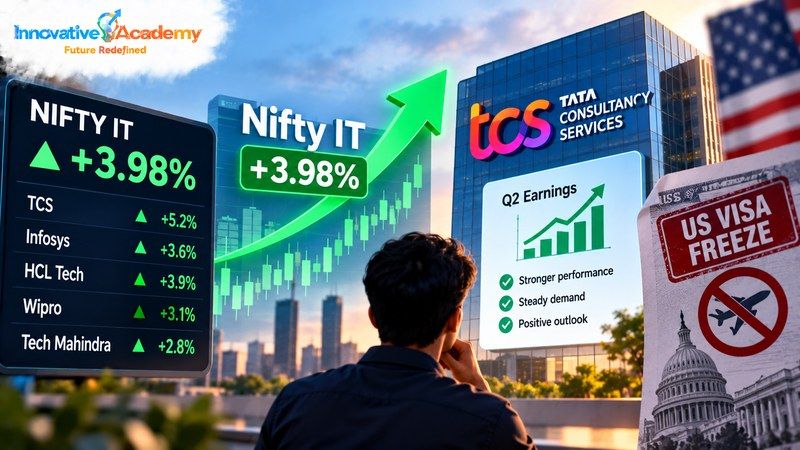
TCS, the first of the big Indian IT firms to report, posted consolidated revenue of ₹73,188 crore for the quarter, up 1.26% quarter-on-quarter and 11.23% year-on-year. In constant-currency terms, growth was a more modest 0.5% quarter-on-quarter, which the company and analysts both treated as roughly in line with expectations, while international revenue grew 1.2% quarter-on-quarter in constant currency. Profit came in at ₹13,884 crore, up from ₹12,075 crore, a roughly 15% year-on-year increase, and the board declared a dividend of ₹12 per share. Markets responded immediately: TCS shares jumped over 6% intraday, and the move rippled across the sector.
3. What's Actually Driving the Beat: AI Revenue Crossing a New Threshold
The detail that gave this report more weight than a routine quarterly beat: TCS's annualized AI-related revenue crossed $3.1 billion, now representing more than 10% of the company's total revenue. That's a genuinely significant milestone for a company of TCS's scale, it means AI-linked work has moved from an emerging line item to a material share of the business, and it's the detail analysts and financial media pointed to as the real story behind the stock's reaction, more than the topline revenue growth itself.
4. The Immigration Story Everyone Expected to Tank This Rally
The timing here is what makes this worth writing about at all. In the same window as these results, the US Department of Labor's suspension of new PERM filings for eight companies, including TCS, Infosys, Wipro, and HCLTech alongside Cognizant, Capgemini, Microsoft, and Adobe, was still fresh, active news. A freeze on a pathway toward US green cards for major Indian IT employers is exactly the kind of headline that should have weighed on these same stocks. Instead, the rally happened alongside it, not despite some delay in the news reaching investors, but with both stories running in the financial press at the same time.
5. Why the Market Didn't Panic, According to the People Watching It
One market analyst, Hariselvan Radhakrishnan of HST Wealth, offered a specific, concrete reason rather than general reassurance: the PERM suspension "does not suspend existing H-1B employment, so the immediate operational impact may be limited." That's a narrower claim than "nothing to worry about," it's specifically about what the freeze does and doesn't touch right now, existing visa holders keep their status, only new and pending PERM filings are frozen. The same analyst did flag a real downside risk if the suspension drags on: rising retention and compliance costs over time, even without an immediate operational hit. Reporting on the day noted plainly that investors simply didn't sell tech stocks over the news, which is itself a data point about how the market is pricing this specific kind of policy risk versus a hit to actual quarterly earnings.
6. A Mismatch Worth Flagging Between the Preview and the Actual Numbers
Before this quarter's results landed, brokerage Kotak Institutional Equities had previewed a genuinely muted set of numbers across the sector, estimating TCS revenue growth of just 0.5% quarter-on-quarter and 2.8% year-on-year, citing persistent macroeconomic uncertainty and what the preview specifically called "AI deflation," pricing pressure from AI-driven productivity gains eating into services revenue. TCS's actual reported year-on-year revenue growth, 11.23%, looks dramatically stronger than that 2.8% estimate at first glance. Worth being precise about why that gap exists rather than reading it as some enormous surprise beat: the Kotak preview and TCS's headline reported figure aren't measuring quite the same thing, constant-currency growth versus reported rupee revenue growth, which includes currency movement, pull in different directions and aren't directly comparable without adjusting for that. The constant-currency figure, 0.5% quarter-on-quarter, is the one that actually lines up with the preview and is the fairer basis for judging whether this was a beat, an inline quarter, or a miss.
7. Reading the Other Four Stocks in the Rally
The rally wasn't confined to TCS alone. Infosys closed up 1.97% with an intraday move past 3.4%, Wipro rose 2.73%, HCLTech gained 1.91% with a near-4% intraday swing, and Tech Mahindra closed up 1.54% with an intraday gain past 2.7%. None of those four had reported their own Q2 results yet at the time of this rally, their gains were riding on TCS's numbers and the sector-wide read that followed, which says something about how closely these stocks move together around the first major earnings report of the season, well before each company's own specific numbers are in.
8. Two Different Risks, Coexisting in the Same Trading Session
What this single trading day actually demonstrates is that a company-specific earnings risk and a sector-wide policy risk don't automatically combine into one bigger risk, they can sit side by side and get priced completely differently by the same investors on the same morning. TCS's AI revenue crossing 10% of its total business is a concrete, reportable, currently-true fact about the company's earnings quality. The PERM suspension's actual damage is still speculative, bounded by "if it drags on," and explicitly described by at least one analyst as limited in its immediate scope. Markets, in this instance, treated the certain thing as the more important one.
9. Building Toward the Skillset Behind the Headline, at Innovative Academy
Innovative Academy's AWS Training program in Bangalore builds exactly the cloud and AI-services foundation that's showing up inside TCS's $3.1 billion AI revenue line, the practical skills behind the specific business segment that's actually been growing fast enough to move a stock price on a single earnings day.
10. FAQs
1. Did the US green card suspension actually hurt TCS's stock price?
No, not on this trading day. TCS shares rose over 6% intraday on the same week the suspension was active news, with an analyst specifically noting the freeze doesn't touch existing H-1B status, only new PERM filings.
2. Was TCS's reported 11.23% year-on-year revenue growth a huge beat over analyst expectations?
Not quite as dramatic as it first looks. A pre-results brokerage preview had estimated only 2.8% year-on-year growth, but that figure was on a constant-currency basis, while the reported 11.23% includes currency effects. The more directly comparable figure, constant-currency growth of 0.5% quarter-on-quarter, was roughly in line with that preview.
3. What specifically drove the stock market's positive reaction?
Analysts and coverage pointed most directly to TCS's annualized AI revenue crossing $3.1 billion and surpassing 10% of total revenue, a concrete sign of AI-linked work becoming a material part of the business, rather than the topline revenue number alone.
4. Did Infosys, Wipro, and HCLTech also report strong results that day?
No, their share price gains on October 9 came before they'd reported their own Q2 numbers. The rally rode on TCS's results and the sector-wide read that followed.
5. Is the PERM suspension risk gone now that the market didn't react negatively?
Not according to the analysts quoted in the coverage. The immediate operational impact is described as limited specifically because existing H-1B employment isn't affected, but a longer suspension carries a real risk of rising retention and compliance costs over time.
11. Final Thoughts
The useful lesson in this single trading session isn't "immigration policy doesn't matter to Indian IT stocks," it's that investors are capable of weighing a concrete, current earnings signal against a bounded, conditional policy risk and treating them as genuinely different kinds of uncertainty. TCS's AI revenue crossing 10% of its business was real and reportable the day it was announced. The PERM suspension's damage is still contingent on how long it lasts. Markets priced the certain thing more heavily, and seeing why that happened tells you more than either headline does by itself.
If you want to build the cloud skills behind this kind of growth, explore AWS Training in Bangalore at Innovative Academy. Contact for course details: 8447712333.