
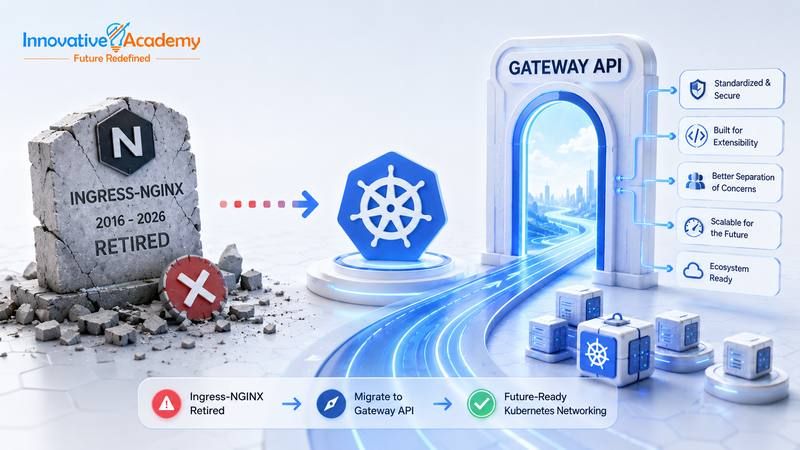

Ingress-NGINX Is Dead: Why Kubernetes Retired It and What to Do About Gateway API
Table of Contents
- Why Was Ingress-NGINX Retired?
- What Happens to Existing Ingress-NGINX Clusters?
- Enter Gateway API
- Why Gateway API Is More Than a Replacement
- But Gateway API Is Not a Drop-In Replacement
- Ingress2Gateway Makes Migration Easier
- A Practical Migration Strategy
- What About Teams That Don't Want Gateway API?
- The Bigger Kubernetes Networking Shift
- Final Takeaway
Kubernetes networking just hit a milestone most platform teams saw coming but nobody wanted to deal with. Ingress-NGINX, one of the most widely used Ingress controllers, has officially retired.
The retirement of Ingress-NGINX marks a real end of an era for a project that made HTTP traffic management on Kubernetes approachable for an entire generation of engineers. Here's the distinction worth holding onto, though: Kubernetes Ingress itself isn't going anywhere.
The Ingress API is still a stable, supported part of Kubernetes, and there's no plan to deprecate it. What ended is the community's maintenance of one specific controller—Ingress-NGINX—that happened to implement that API using NGINX under the hood.
Best-effort maintenance ran through March 2026, and once that window closed, the Ingress-NGINX repository was archived and made read-only. If you're running it today, nothing breaks overnight—existing installations keep working, and the container images and Helm artifacts aren't going anywhere.
What you won't get anymore is new releases, bug fixes, or security patches.
So if your team is still on Ingress-NGINX, here's the honest take: don't panic, but don't shrug it off either. The recommended path is to start evaluating the Gateway API, or another actively maintained Ingress controller, and begin a controlled migration on your timeline.
At Innovative, our DevOps and cloud consulting team—along with the students in our DevOps training programs here in Bangalore—has been fielding this exact question for months now. So we figured it was worth writing down what every platform team should know before deciding how to move.
Why Was Ingress-NGINX Retired?
Ingress-NGINX got popular for a simple reason: it let you expose Kubernetes apps to HTTP and HTTPS traffic without needing to become an expert in load-balancer infrastructure first. It just worked, and it worked for almost anyone.
The same flexibility that made it popular also made it harder to maintain. A lot of what teams actually relied on—features that weren't part of the core Ingress API—was bolted on through annotations, ConfigMaps, and other controller-specific tricks.
That created two headaches. One, configurations stopped being portable: an annotation that worked beautifully in Ingress-NGINX might mean nothing to a different controller.
Two, and more seriously, some of that flexibility opened real security holes. Kubernetes specifically pointed to the ability to inject arbitrary NGINX configuration through snippet annotations as a case where a once-useful feature had quietly turned into a security and maintenance liability.
There was also a people problem underneath all of this. Kubernetes has been candid that Ingress-NGINX ran for years on a very small number of people working on this in their spare time—not exactly a sustainable footing for something this many production clusters depend on.
Once it became clear there weren't enough hands to keep the project at the security bar it needed, SIG Network and the Security Response Committee made the call: retirement was the responsible move, not a failure.
What Happens to Existing Ingress-NGINX Clusters?
Retirement doesn't mean your apps stop working tomorrow. An existing Ingress-NGINX deployment keeps serving traffic just fine—Kubernetes has been explicit that nothing currently running will break, and the existing artifacts aren't disappearing.
The real problem shows up later.
If someone finds a new vulnerability in the retired controller, there's no team left to ship a fix. No more compatibility work as Kubernetes itself evolves, and no more routine bug fixes—the project is frozen exactly where it stands.
And this scenario isn't a "someday" risk anymore. In mid-2026, CVE-2026-4342 was publicly disclosed—a high-severity, comment-based NGINX configuration-injection vulnerability hitting every Ingress-NGINX version below v1.13.9, v1.14.5, and v1.15.1.
Because the project is now end-of-life, there's no patched release coming for it. It's simply sitting there, unfixed, in any cluster still running an affected version.
This situation is the exact scenario the retirement announcement warned about, and it's already happened rather than waiting to.
That's what turns the situation from an operational footnote into a genuine security and lifecycle question. A cluster that's humming along fine today can still be quietly carrying an unsupported piece of networking infrastructure.
Checking whether a cluster is running Ingress-NGINX is a one-line kubectl query against pods across all namespaces, filtered on the standard Ingress-NGINX app label. It's usually the very first thing we run when we kick off a Kubernetes security assessment for a new client.
Kubernetes' own advice is to check now rather than assume you're unaffected, and given CVE-2026-4342, checking your running version against those patched-below thresholds—v1.13.9, v1.14.5, and v1.15.1—is worth doing today.
Check before you schedule the migration project, not after.
Enter Gateway API
Gateway API is Kubernetes' newer take on service networking, built as the next generation of Ingress, load-balancing, and service-mesh APIs rolled into one coherent model.
Instead of cramming most of the configuration into a single Ingress resource, Gateway API spreads responsibility across a small set of purpose-built resources:
- GatewayClass — identifies which Gateway implementation you're using.
- Gateway — defines how traffic actually enters the cluster.
- HTTPRoute — defines how HTTP requests are routed to your applications.
- GRPCRoute and other route resources handle protocol-specific routing needs.
That separation is probably the single biggest architectural difference between the two models.
Ingress squashes routing, TLS, and controller-specific configuration into a single resource that sits right in front of a Service. The Gateway API instead layers GatewayClass, Gateway, and HTTPRoute on top of each other before traffic ever reaches the service.
It's more moving parts, sure—but it gives infrastructure teams and application teams a much clearer line around who owns what.
Why Gateway API Is More Than a Replacement
It would be easy to dismiss Gateway API as Ingress with a new name slapped on it. That's not really what's happening.
One of its core goals is making Kubernetes networking role-oriented, expressive, portable, and extensible—all things the original Ingress spec was never really designed to be.
Better Separation of Responsibilities
With classic Ingress, one resource usually handles routing and infrastructure concerns, and whoever set it up first owns it.
Gateway API pulls them apart: a cluster operator manages the Gateway and its listeners, while application teams manage the HTTPRoutes that attach to those listeners.
If you've ever had multiple teams stepping on each other's Ingress rules on a shared cluster, you'll recognize immediately why this distinction matters.
Less Dependence on Annotations
Ingress controllers have long leaned on annotations to bolt on capabilities the base Ingress API never provided.
Gateway API moves a lot of that into structured, first-class API fields instead. Traffic splitting, header-based routing, redirects, rewrites—these can now be expressed directly through Gateway API resources rather than through a pile of controller-specific annotations.
More Expressive Routing
Ingress was intentionally minimal. Gateway API expands the routing model considerably—advanced matching, traffic management, cross-namespace patterns, richer TLS configuration, and protocol-specific routes.
If you're running microservices at any real scale, that richer model tends to mean less controller-specific glue code to maintain over time.
But Gateway API Is Not a Drop-In Replacement
This is the part where migration teams need to slow down.
You can't just swap resource kinds and expect the behavior to carry over unchanged. Ingress-NGINX configurations are full of annotations and edge-case behaviors that simply don't have a clean one-to-one match in Gateway API.
Kubernetes has been upfront that some of these differences can be genuinely surprising.
Regex matching is the classic example—behavior that worked one way under Ingress-NGINX can translate differently under Gateway API, and suddenly requests that used to succeed start coming back as 404s.
The takeaway is that migration needs real behavioral testing, not just a YAML conversion pass.
Honestly, this is the step our clients are least likely to want to skip—nobody wants to find out about a routing regression from a customer.
Ingress2Gateway Makes Migration Easier
The good news is Kubernetes hasn't just told everyone to go figure this out alone—there's real tooling behind the migration.
Ingress2Gateway translates existing Ingress resources, including implementation-specific configuration, into their Gateway API equivalents.
In March 2026, the project hit its 1.0 release, and the annotation coverage jumped significantly. It now handles full CORS configuration, backend TLS translated into a BackendTLSPolicy resource, regex path matching, and path rewriting, on top of header manipulation, gRPC support, canary routing, timeout configuration, SSL redirects, IP access control, and buffer sizing.
Just as importantly, the tool flags what it can't translate cleanly.
That matters more than it sounds like it should—a migration tool that silently produces YAML and calls it done is far more dangerous than one that tells you where to look twice.
A Practical Migration Strategy
If your organization runs Ingress-NGINX, treat this as a project with real phases, not a quick configuration swap.
This is more or less the sequence our managed Kubernetes migration teams walk clients through in Innovative's cloud and DevOps programs—the same hands-on Kubernetes training and cloud DevOps certification work that turns a one-off fire drill into a repeatable skill your team owns going forward.
For teams looking to build these skills systematically, you can also explore our DevOps and Cloud training programs at Innovative Academy.
Step 1: Find Every Ingress-NGINX Deployment
Start by mapping every cluster and namespace that is actually running the controller.
Don't trust documentation alone—production environments have a way of quietly accumulating old apps and inherited networking configurations nobody remembers setting up.
Step 2: Inventory Your Annotations
Build a real list of every Ingress-NGINX annotation currently in use.
Pay particular attention to:
- Authentication
- TLS configuration
- Redirects
- Rewrites
- Regex routing
- Rate limiting
- Header manipulation
- CORS
- Backend protocols
- Custom NGINX snippets
These are precisely the areas where a naive migration tends to produce the most unpleasant surprises.
Step 3: Select a Gateway API Implementation
Gateway API is a specification, not a product—it doesn't ship with one universal controller.
Several implementations exist, so weigh them on compatibility, conformance, the underlying proxy technology, cloud integration, your operational requirements, and how much expertise your team already has with a given platform.
Step 4: Run Gateway API Alongside Ingress-NGINX
You don't have to rip the old controller out on day one.
Kubernetes' own migration guidance recommends running a Gateway API controller alongside Ingress-NGINX during testing so you can validate the new setup without touching production traffic yet.
Step 5: Test Real Application Behavior
Getting the YAML to apply cleanly is the easy part. Actually validate:
- HTTP and HTTPS traffic
- TLS termination
- Redirects
- Host-based routing
- Path-based routing
- Regex behavior
- Authentication
- Headers
- WebSockets
- gRPC
- Timeouts
- Health checks
- Error handling
A configuration can look perfectly valid and still quietly change how your application behaves.
Step 6: Shift Traffic Gradually
Once you've validated the Gateway API setup, move traffic over gradually—not in one big cutover.
Monitor HTTP error rates, latency, TLS failures, application availability, gateway/controller logs, and resource utilization.
Only decommission the old controller once the new path has actually proven itself stable under real traffic.
What About Teams That Don't Want Gateway API?
Gateway API is where Kubernetes wants everyone headed, but it's not the only legitimate option.
Plenty of organizations will find another actively maintained Ingress controller fits their needs better, especially if they're deeply invested in the traditional Ingress model.
Nobody's forcing an immediate replacement.
What genuinely doesn't make sense anymore is leaving a retired Ingress-NGINX running indefinitely and treating it like it's still a supported piece of security-critical infrastructure.
That ship has sailed.
The Bigger Kubernetes Networking Shift
Zoom out, and the retirement of Ingress-NGINX is really a symptom of a larger shift in how Kubernetes networking is being rethought.
Early Kubernetes leaned heavily on simple APIs paired with powerful, opinionated controllers, and for a while that worked great.
As clusters grew and more teams started sharing the same infrastructure, the cracks started showing—clear ownership boundaries, stronger security controls, portable configuration, richer routing, real multi-team support, and easier interoperability between different implementations.
Those became things platform teams actually needed, and the original Ingress model was never built with all of that in mind.
Gateway API was designed specifically around those gaps.
Yes, the migration takes real engineering effort. But it's also a genuine opportunity to clean up years of accumulated annotations, undocumented behavior, and controller-specific configuration that nobody fully understands anymore—the kind of modernization work for cloud infrastructure that quietly pays for itself well past the migration itself.
Final Takeaway
Ingress isn't dead. Ingress-NGINX is.
The Ingress API remains a stable, supported part of Kubernetes. What's reached the end of its road is the community-maintained Ingress-NGINX controller specifically.
Existing deployments will keep running, but they won't get the security and maintenance updates a modern production platform actually needs—and with CVE-2026-4342 already circulating unpatched, that's not some distant, theoretical risk anymore.
If your team is still on Ingress-NGINX, the right move isn't to remove everything all at once.
- Inventory what you're running.
- Understand your annotations—all of them.
- Pick a Gateway API implementation that fits.
- Lean on migration tooling where it helps.
- Run the old and new paths side by side.
- Test real traffic behavior.
- Move production workloads over gradually.
Gateway API is simply a more structured way to think about Kubernetes networking, and the sooner your team starts planning for that shift, the easier it'll be when you actually make it.
If you want a second opinion on where to start, or you'd rather build this expertise in-house, Innovative runs a project-based DevOps Engineering Bootcamp with placement support out of Bangalore, alongside focused AWS DevOps training and Azure cloud training tracks.
If you'd rather just talk it through, Innovative's DevOps consulting practice can also help scope a Kubernetes Gateway API migration alongside your team.