

India Wants a Real Slice of the Chip Industry — Here Are the Five Numbers Behind That Bet
1. Introduction
A report filed from New Delhi on October 12, 2026 lays out, in specific dollar figures, how seriously India's government is now treating semiconductors: an "urgent national priority," in its own words, after importing roughly $150 billion worth of microchips between 2017 and 2025. The numbers behind that framing are worth walking through individually, because the same reporting that makes the case for India's chip ambitions also includes a pointed warning about whether any of it actually works.
2. Why Now: The Number That Explains the Urgency
Start with the number that frames everything else: roughly $150 billion in microchips imported into India between 2017 and 2025. That's not a one-year figure, it's nearly a decade of dependence on chips made elsewhere, feeding everything from phones to cars to data centers, and it's the specific gap the government's current push is aimed at closing rather than a vague ambition to "do more in tech."
3. Move One: Chips as a Declared National Priority
The first and most direct move is simply political framing with money behind it: more than $20 billion in government support has been pledged specifically for chip production, treating semiconductor manufacturing the way a country treats energy security or food security, as infrastructure too strategically important to leave entirely to import markets.
4. Move Two: Electronics Manufacturing's Actual Growth Curve
Second, and distinct from chip fabrication itself, is electronics manufacturing more broadly, assembling the phones, devices, and components that chips go into. That sector's output grew from roughly $31 billion in 2014-15 to about $133 billion in 2024-25, better than a fourfold increase over a decade, with Apple and Samsung both named among the companies building out assembly operations in the country. That's real, measurable growth that predates the current chip-specific push and gives the broader strategy a track record to point to, rather than starting from zero.
5. Move Three: A Data Center Buildout Still Being Counted
Third is the data center side of the AI infrastructure story. India currently holds only about 3% of global data center capacity, a small base, but one with roughly $70 billion in projects already under construction and another $90 billion announced on top of that. Reliance, Adani, Amazon, Microsoft, Meta, and Google are all named as players building in this space, and Google specifically is constructing a $15 billion AI hub in Visakhapatnam. That's a genuinely large pipeline relative to the current 3% share, though it's worth being clear that "announced" and "under construction" are two different stages of certainty, and not every announced dollar necessarily becomes a running data center on the original timeline.
6. Move Four: Betting on an Already-Trained Workforce
Fourth is the workforce argument, and it's the one with the most specific, checkable numbers behind it: India claims nearly 20% of the global chip-design workforce, with roughly 70,000 design engineers trained over just the past four years. Engineering colleges have also expanded semiconductor-specific coursework to support this pipeline. Design talent and fabrication capacity are different things, a country can have strong chip designers without yet having the fabs to build what they design, but a trained workforce is a genuine, difficult-to-fake asset if the manufacturing side eventually catches up.
7. Move Five: Where the Plants Actually Stand Today
Fifth, and most concrete: five assembly, testing, and packaging plants are already in commercial production, with seven more projects approved and in the pipeline. Named players include Micron, Kaynes, CDIL, Suchi Semicon, and CG Semi, alongside Tata Electronics, which is building a plant in Gujarat with Taiwan's PSMC as a technology partner. Assembly, testing, and packaging is a meaningfully different, less advanced stage of the chip supply chain than the kind of cutting-edge fabrication TSMC or Samsung run, worth being precise about that distinction rather than letting "semiconductor plant" imply more than these specific facilities actually do.
8. The Tension the Report Doesn't Smooth Over
Here's the detail that keeps this story from reading as straightforward good news: the same broad push toward AI infrastructure and chip manufacturing is happening alongside a specific warning, attributed to Nomura, describing India as "ground zero" for AI-driven job disruption in Asia. Those two things, a country racing to build the infrastructure AI runs on while also being flagged as unusually exposed to the jobs AI displaces, aren't contradictory so much as two sides of the same transition, but reporting one without the other would be an incomplete picture. On the feasibility side specifically, Arvind Gupta of the Digital India Foundation is quoted raising three concrete obstacles: access to global capital, attracting and retaining top technical talent, and sourcing the hardware needed to actually build these facilities, obstacles that exist independently of how much money gets pledged on paper.
9. What the Market Itself Is Projected to Become
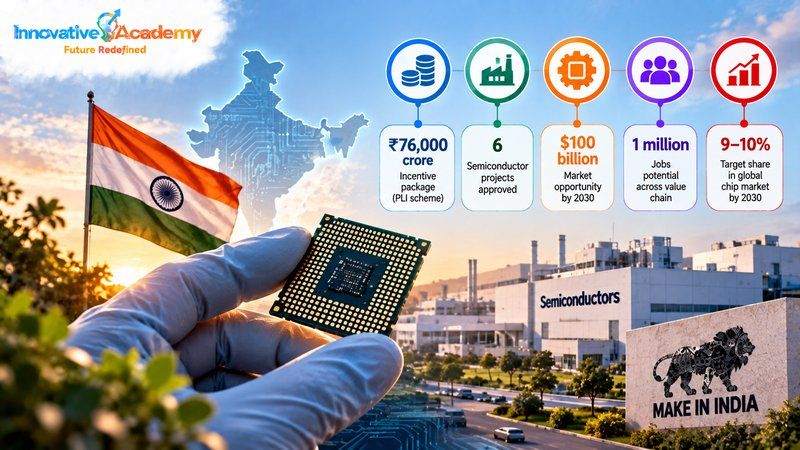
Government figures cited in the reporting put India's current semiconductor market at roughly $50 billion in 2026, projected to reach $110 billion by 2030 and over $200 billion by 2035. Separately, AI-linked jobs specifically are projected to nearly double to 1.25 million by 2027. Worth treating both of these as projections rather than locked-in outcomes, they're the government's own stated targets, and the gap between a stated target and an achieved one is exactly the thing the capital, talent, and hardware-sourcing concerns above are about.
10. Building the Hardware Literacy at Innovative Academy
Innovative Academy's Hardware & Networking program in Bangalore teaches the foundational understanding of how chips, systems, and networks actually fit together, the same base knowledge that underpins every stage of the supply chain this report describes, from assembly and testing plants running today to whatever more advanced fabrication capacity India eventually builds.
11. FAQs
1. Is India already manufacturing advanced semiconductor chips like TSMC or Samsung does?
Not yet at that level. The five plants currently in commercial production are assembly, testing, and packaging facilities, a less advanced stage of the chip supply chain than cutting-edge fabrication, though seven more such projects are approved.
2. How much has India actually spent on this push versus just announced?
The government has pledged more than $20 billion specifically for chip production, and $70 billion in data-center projects are already under construction, with another $90 billion announced but not yet necessarily broken ground on. Announced and under-construction figures represent different levels of certainty.
3. Does India have the people to actually design chips, even without building them locally?
Yes, by the numbers in this reporting, India already claims nearly 20% of the global chip-design workforce, with about 70,000 design engineers trained in just the past four years.
4. Is anyone skeptical that this push will actually work?
Yes, directly within the same reporting. Arvind Gupta of the Digital India Foundation specifically flags access to global capital, talent retention, and hardware sourcing as real obstacles, independent of how much funding gets announced.
5. Is India's AI infrastructure buildout good news for Indian tech jobs overall?
It's genuinely mixed. The same period sees major investment in AI data centers and chip manufacturing jobs, while Nomura is cited describing India as particularly exposed to AI-driven job disruption, two trends running in parallel rather than one simply canceling out the other.
12. Final Thoughts
The honest way to read this report is as a country making a large, specific, partially-funded bet rather than a done deal. The five billion-dollar-plus moves, national-priority framing, electronics manufacturing growth, a growing data center pipeline, a trained design workforce, and plants already running, are all real and already happening to some degree. Whether they add up to the $110 billion and then $200 billion-plus market the government is projecting depends on exactly the obstacles the same reporting names directly: capital, talent, and hardware access. That's the part worth tracking, not just the headline investment figures.
If you want to build the hardware fundamentals behind stories like this one, explore the Hardware & Networking Course in Bangalore at Innovative Academy. Contact for course details: 8447712333.