
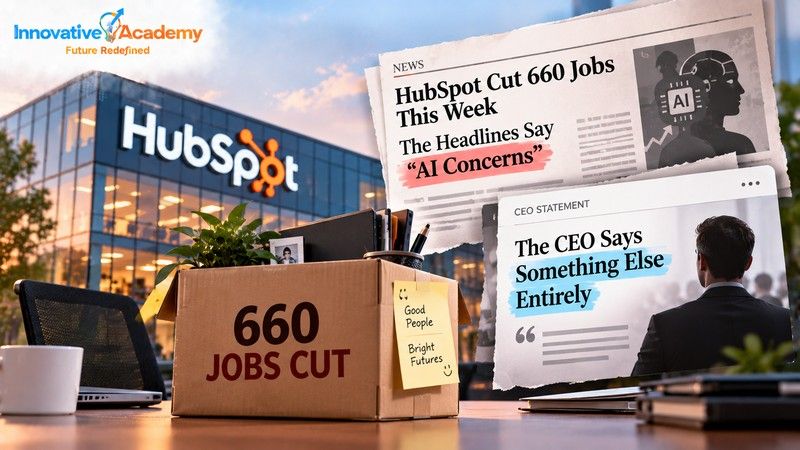

HubSpot Cut 660 Jobs This Week — the Headlines Say "AI Concerns," the CEO Says Something Else Entirely
Table of Contents
- 1. Introduction
- 2. What HubSpot Actually Announced
- 3. What the CEO Actually Said
- 4. Where the "AI Concerns" Framing Is Actually Coming From
- 5. Two Different Questions Getting Collapsed Into One Headline
- 6. The Financial Picture Underneath Both Framings
- 7. Why This Particular Gap Is Worth Noticing
- 8. What This Means for Anyone Building a Tech Career
- 9. Building Resilient Technical Skills at Innovative Academy
- 10. FAQs
- 11. Final Thoughts
1. Introduction
HubSpot announced it's cutting 660 jobs this week, and depending on which headline someone reads first, they'd walk away with two genuinely different explanations for why. Several outlets are running the story "amid AI concerns." HubSpot's own CEO, in the memo announcing the cuts, said plainly that they are not a direct result of AI replacing jobs inside the company. Both things are, in a specific and limited sense, true at the same time — which is exactly the kind of gap worth actually reading closely rather than picking whichever headline is more dramatic.
2. What HubSpot Actually Announced
HubSpot disclosed the cuts in an SEC filing on Tuesday, October 6, 2026, with the board having approved the plan on October 1. The reduction totals roughly 660 positions, about 7% of the company's global workforce. HubSpot expects to record $65 million to $75 million in related charges, mostly severance, notice pay, and transition benefits, with most of that cost landing in the fourth quarter of fiscal 2026 and the restructuring itself wrapping up by the end of the first quarter of 2027. Severance terms reported by the Boston Globe include at least 20 weeks of base salary for affected employees.
3. What the CEO Actually Said
In a memo to employees, CEO Yamini Rangan described the changes as organizational rather than financial: cutting management layers and pushing decision-making closer to frontline staff, alongside a broader shift in how the company organizes its product and go-to-market teams. Her own words, as reported: "That shift is transforming product, pricing and how we serve our customers," and separately, "we also need to fundamentally change the way we are organized to compete and win." Most directly relevant to the AI question specifically, she's reported to have said the cuts are not merely cost-cutting and not a direct result of AI replacing jobs within the company.
4. Where the "AI Concerns" Framing Is Actually Coming From
The "amid AI concerns" headlines aren't fabricated out of nothing — they're drawing on a real, separate layer of context. HubSpot's stock has fallen more than 40% so far this year, a decline tied partly to broader investor worry that AI is reshaping the competitive landscape for enterprise software companies like HubSpot. Specifically, the concern is that smaller customers are increasingly capable of building their own CRM-adjacent tools using AI, rather than paying for a full HubSpot subscription — a demand-side threat to the business, not a story about AI taking over internal HubSpot jobs. Coverage has also pointed out that HubSpot isn't alone in this: Salesforce, ServiceNow, and Atlassian have all made cuts of their own this year, feeding a narrative that enterprise SaaS broadly is under AI-driven pressure.
5. Two Different Questions Getting Collapsed Into One Headline
This is really the crux of the gap: "is AI threatening HubSpot's business model" and "is AI directly replacing the specific 660 people being let go" are two different questions, and the available reporting answers them differently.
The stock decline and competitive-pressure narrative speak to the first question, and there's real substance behind it — a company whose core product category is being reshaped by AI-capable alternatives is a legitimate, documented concern. Rangan's statement speaks to the second, narrower question, and on that specific point, she's on record rejecting a direct causal link between AI and the actual headcount decision.
A headline that says "HubSpot cuts jobs amid AI concerns" isn't technically wrong about the first question, but it invites a reader to assume an answer to the second question that the company's own executive has specifically pushed back on.
6. The Financial Picture Underneath Both Framings
Whichever framing gets emphasized, the underlying financial picture is the same, and it's worth looking at directly rather than through either narrative. HubSpot reaffirmed its third-quarter and full-year 2026 revenue and non-GAAP operating income guidance alongside the layoff announcement, and the restructuring charges will be excluded from non-GAAP results — the company's own framing is that it remains on track for its longer-term margin targets despite the stock's decline.
That's a company managing a real reorganization while publicly maintaining its financial targets, not one issuing a profit warning alongside the cuts, which is a meaningfully different situation than a company whose layoffs come bundled with lowered guidance.
7. Why This Particular Gap Is Worth Noticing
The honest reading isn't "the media is wrong" or "the CEO is spinning it" — both framings can be accurate about the specific, narrower thing each one is actually claiming, which is exactly what makes this worth slowing down on rather than accepting either version at face value.
AI-driven competitive pressure on HubSpot's product category is real and well-documented. A direct causal claim that AI specifically replaced these 660 people's jobs isn't something the company's own executive supports, and the available reporting doesn't independently establish it either.
Treating "AI concerns" as shorthand for "AI did this" is the exact kind of collapse that makes an actually nuanced business story sound simpler, and scarier, than what the primary source itself says.
8. What This Means for Anyone Building a Tech Career
Whatever the precise mechanism behind this specific round of cuts, the broader pattern underneath it, enterprise software companies reorganizing in response to AI reshaping their competitive landscape, isn't going away, and it's a different kind of pressure than the layoffs covered elsewhere that are more directly about internal automation.
The practical takeaway is similar either way: capability that's easy to demonstrate and that transfers cleanly from one employer to the next doesn't depend on which story ends up attached to any particular company's restructuring.
Getting into the habit of tracing a layoff headline back to what the company actually said, rather than stopping at the framing a given outlet chose, is itself a useful skill for navigating a stretch of tech coverage where this kind of ambiguity has become routine.
9. Building Resilient Technical Skills at Innovative Academy
Innovative Academy's DevOps Bootcamp in Bangalore is built around exactly the kind of demonstrable, cross-tool capability that travels between employers regardless of how any single company's restructuring gets framed in the press — six months of hands-on work across the pipeline, rather than certification-only knowledge that depends on one employer's specific tech stack staying stable.
Interested in DevOps? Explore the DevOps Bootcamp Training in Bangalore at Innovative Academy, or call 8447712333 for course details.
10. FAQs
1. Did AI actually cause HubSpot's layoffs?
Not according to the company's own CEO, who specifically said the cuts aren't a direct result of AI replacing jobs within HubSpot. There is a separate, well-documented concern about AI-driven competitive pressure on HubSpot's business overall, but that's a different claim from AI directly displacing these specific roles.
2. Is HubSpot in financial trouble?
The company reaffirmed its Q3 and full-year 2026 revenue and operating income guidance alongside the announcement, and says it's on track for its longer-term margin targets. A company issuing a profit warning alongside its layoffs would look considerably different from this — here, the stock's decline traces more to broader investor sentiment about AI's effect on the sector than to any specific cut to HubSpot's own guidance.
3. Which teams at HubSpot are affected by the cuts?
Available reporting doesn't specify exact departments. What is specified is the structural goal: cutting management layers and pushing decisions closer to frontline staff, alongside reorganizing product and go-to-market teams.
4. How does this compare to the Workday layoffs covered previously?
Workday explicitly declined to attribute its 2026 layoffs to AI at all, in either of its two rounds this year. HubSpot's situation is more layered: the company's own CEO similarly rejects a direct AI-replacing-jobs claim, but unlike Workday, HubSpot's stock decline and media coverage are explicitly tied to AI-driven competitive concerns about the business itself, not just general financial pressure.
5. What severance are affected employees getting?
Reported terms include at least 20 weeks of base salary, on top of notice pay and transition benefits, funded by the $65 million to $75 million in charges HubSpot expects to record mostly in the fourth quarter of fiscal 2026.
11. Final Thoughts
HubSpot's 660 job cuts are a genuinely useful case study in how a true statement about an industry ("AI is pressuring enterprise SaaS business models") and a true statement about a specific decision ("these particular layoffs weren't caused by AI replacing these jobs") can both hold at once without contradicting each other, even though collapsing them into a single headline makes it look like they do.
Reading past the headline to what the primary source actually said is the only way to tell which claim a given piece of coverage is really making.