
Five Questions to Ask Before Picking Your Next IT Certification in 2027
Table of Contents
- 1. Introduction
- 2. Question One: Is This Skill Growing, Shrinking, or Just Stable?
- 3. Question Two: Does It Stand Alone, or Does It Need a Foundation Underneath It?
- 4. Question Three: Can You Actually Prove You Can Do It?
- 5. Question Four: Does It Travel Between Cities and Employers?
- 6. Question Five: Are You Choosing a Skill or a Combination?
- 7. Putting the Framework Together
- 8. Conclusion
- 9. FAQs
1. Introduction
Every year brings a fresh wave of confident advice about which IT skill to learn next, and most of it collapses into a single instruction: learn whatever is trending. That advice isn't wrong exactly, but it's incomplete in a way that matters. Trending and worth your time aren't automatically the same thing, and India's IT job market heading into 2027 is a useful case study in why.
Rather than handing you another list of numbers to skim past, here's a framework: five questions worth actually considering before committing months of study time to any one certification path.
2. Question One: Is This Skill Growing, Shrinking, or Just Stable?
This sounds obvious, but most people skip it and go straight to "what's popular right now," which is a different question entirely. Popularity is a snapshot; the growth trajectory shows a direction.
A skill can be enormously popular today and already past its peak. Many professionals are still hired for manual QA testing and general IT helpdesk work, for instance, even as AI-assisted tooling changes the amount of routine and repetitive work involved in those categories.
Meanwhile, categories such as cloud infrastructure, DevOps, and AI-adjacent engineering continue to receive attention because the underlying technology infrastructure supporting modern businesses keeps expanding.
The practical test is simple: don't just ask, "Are people hiring for this role right now?" Ask, "Will the volume of work in this category likely be bigger or smaller three years from now?"
That second question is harder to answer, but it is the one that matters when you're about to invest significant time and money in a certification.
3. Question Two: Does It Stand Alone, or Does It Need a Foundation Underneath It?
Some skills are genuinely standalone. You can learn them in isolation and immediately apply them. Others quietly assume that you already have a foundation underneath them.
AI and machine learning specialization is a good example of the second category. Although AI is attracting significant investment and attention, many technical roles associated with it also require knowledge of cloud infrastructure, data pipelines, programming, and systems architecture.
This distinction matters enormously when deciding where to start. Jumping directly into an advanced specialization without understanding its underlying technologies can produce a credential that looks impressive on a resume but becomes difficult to demonstrate during a technical interview.
A more structured approach is to build strong cloud and systems fundamentals first, then add a specialization once the foundation is solid.
For learners interested in cloud infrastructure, the AWS training program in Bangalore can be explored as part of a broader cloud learning path.
4. Question Three: Can You Actually Prove You Can Do It?
Employers increasingly look beyond certificates when evaluating technical candidates. Demonstrable skills, practical exposure, projects, and the ability to troubleshoot real situations can all matter when assessing whether someone can perform the work.
That changes the calculus for choosing a certification. A credential supported by genuine hands-on lab work can give learners opportunities to practise configuring infrastructure, troubleshooting deployments, working with command-line tools, and solving realistic technical scenarios.
Before enrolling in any program, ask how much of the training is genuinely hands-on compared with lecture-based learning. More importantly, ask what you will actually be able to build, configure, troubleshoot, or demonstrate by the end of the program.
The answer can tell you more about the practical value of a training program than the name of the certification alone.
For learners building a DevOps-focused skill set, explore the DevOps Bootcamp training in Bangalore to understand how cloud and DevOps concepts can be combined with practical learning.
5. Question Four: Does It Travel Between Cities and Employers?
Not every valuable IT skill has the same level of portability. Some specializations are concentrated around particular industries, cities, or groups of employers.
Core skills such as cloud computing, DevOps, networking, and software engineering are used across many technology environments. This can provide greater flexibility for professionals who may eventually relocate or work with organizations based in another city.
If there is any possibility that you might move for work or pursue opportunities outside your current location, portability deserves serious consideration.
A skill that is useful across different employers and technology environments gives you a broader range of potential applications than one tied to a very specific ecosystem.
You can also explore networking fundamentals training as a foundation for careers involving cloud infrastructure, network administration, and related IT roles.
6. Question Five: Are You Choosing a Skill or a Combination?
One of the most important considerations when planning an IT career is whether you are developing one isolated skill or building a combination of complementary capabilities.
Cloud infrastructure plus DevOps is one example. Data engineering combined with practical AI knowledge is another. The advantage of combining complementary skills is that you can understand a larger part of a technical workflow instead of focusing exclusively on one narrow layer.
This is worth considering before choosing a single certification and stopping there. A strong career pathway can often be built by layering skills deliberately: establish a technical foundation, add a complementary specialization, and then develop enough practical experience to apply both in real projects.
For example, learners can explore AWS DevOps training in Bangalore as a pathway that combines cloud and DevOps concepts.
7. Putting the Framework Together
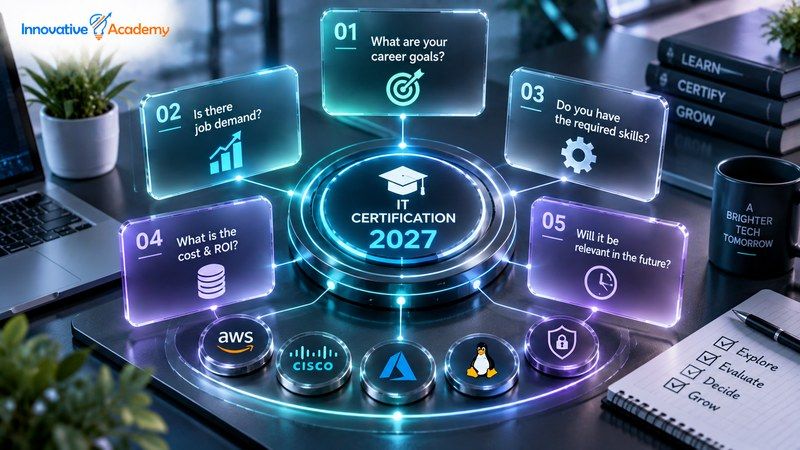
Run any certification you're considering through all five questions honestly, and a pattern tends to emerge:
- Is the underlying skill growing, shrinking, or remaining relatively stable?
- Can the skill stand alone, or does it require a foundation?
- Can you demonstrate practical ability rather than simply show an exam credential?
- Is the skill useful across different cities and employers?
- Can it be combined with another complementary technical skill?
Cloud computing and DevOps fundamentals can form a useful combination because they address infrastructure, automation, deployment, and operational requirements that appear across many modern technology environments.
The important point is not that one particular certification is universally correct. The better approach is to evaluate the underlying skills against your own career goals, existing experience, and the type of technical work you want to perform.
8. Conclusion
The right next certification isn't necessarily the one everyone's talking about this month. A more useful choice is one that survives an honest examination of growth trajectory, foundation requirements, practical proof, portability, and how well it combines with other skills.
This framework provides a way to look beyond short-term trends and evaluate whether a certification can contribute to a broader technical career path.
Innovative Academy in Bangalore offers training across AWS, Azure, networking, Linux, and DevOps, with hands-on learning and placement assistance designed to support learners as they build practical IT skills.
9. FAQs
1. I already have a few years of general IT experience. Does this framework still apply to me?
Yes. It can be particularly useful for experienced professionals because the focus shifts toward whether a new certification adds demonstrable skills to your existing experience. When considering an upskilling or career-switching path, practical ability and relevant technical knowledge can be more useful than simply accumulating additional credentials.
2. What if the skill I'm most interested in doesn't pass all five questions?
That's not necessarily a reason to abandon it. Interest, aptitude, long-term career goals, and the type of work you enjoy also matter. The framework is designed to make the trade-offs visible rather than provide one universal answer.
3. Is cloud computing really a safer bet than specializing directly in AI?
Cloud computing and AI serve different purposes, and both can be valuable areas of study. Many AI-related technical roles also interact with cloud infrastructure, data systems, and software engineering. Building a strong foundation in these areas before adding an AI specialization can therefore be one possible learning sequence, particularly for learners who are starting with limited infrastructure experience.
4. Should I get multiple IT certifications?
Not necessarily. The number of certifications is less important than whether they contribute to a coherent skill set. A combination of complementary knowledge, practical projects, and demonstrable technical ability can be more meaningful than collecting unrelated certifications.
5. What should I check before joining an IT certification course?
Check the curriculum, practical lab exposure, project work, trainer experience, learning support, assessment methods, and career or placement assistance. Also consider whether the course matches your current technical foundation and the type of role you want to pursue.