

Cisco + Supermicro: When Your Networking Vendor Becomes a Server Company
Table of Contents
- Why Cisco Is Doing This
- This Isn't Just a Cisco Story
- What This Means for IT Admins and Architects
- How This Compares to Past Shifts in IT
- The Full-Stack Skill Map This Shift Is Creating
- Why This Matters for Your IT Career
- Frequently Asked Questions
- The Bigger Picture
- Final Thoughts
- Related Programs at Innovative Academy
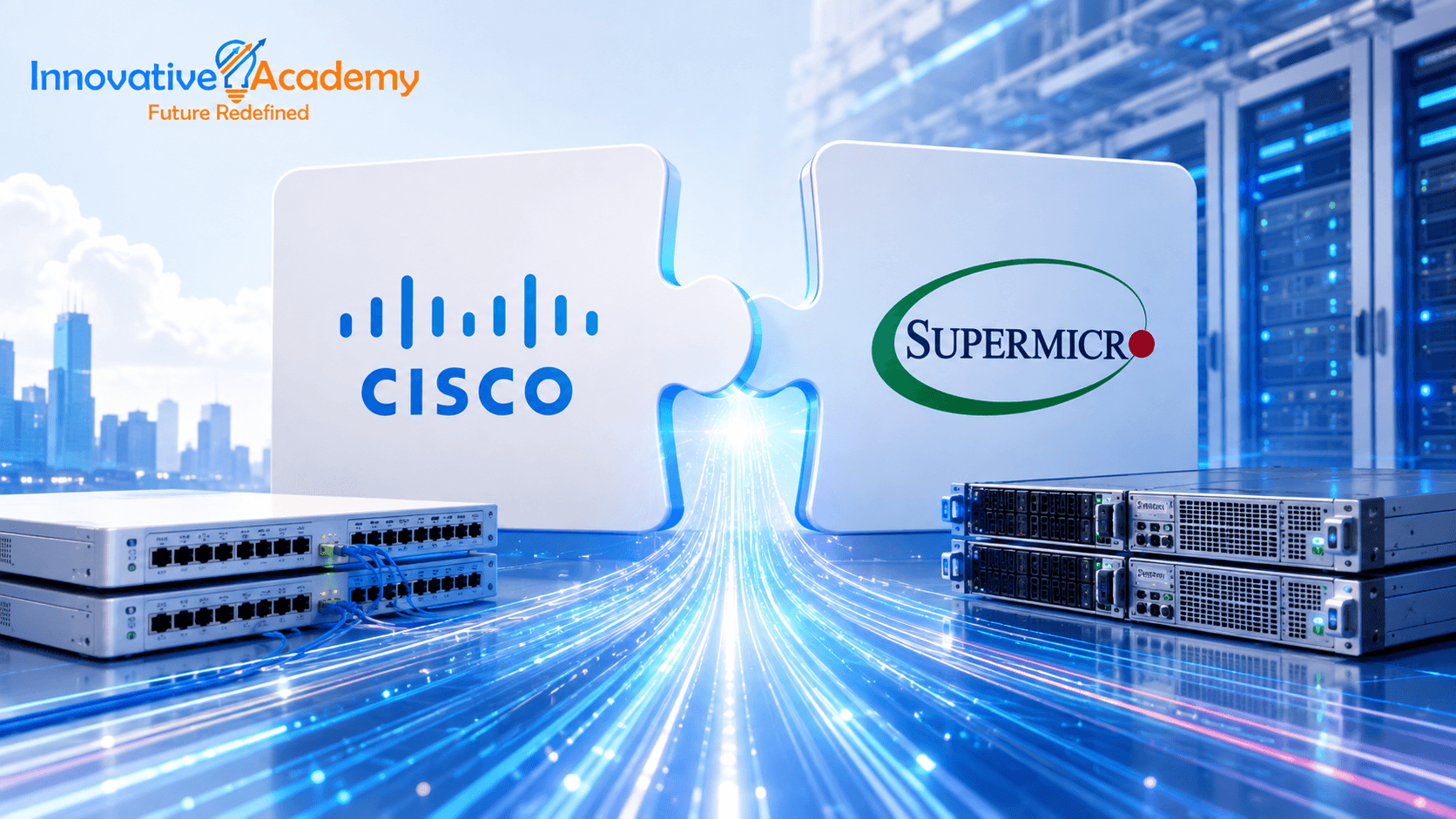
For decades, IT infrastructure followed a simple pattern: Cisco built the network while companies like Supermicro, Dell, and HPE built the servers. Today, that separation is becoming less clear as Cisco partners with Supermicro to deliver integrated AI server infrastructure combining networking, compute, and GPU systems.
This shift matters for network engineers, cloud architects, system administrators, and students preparing for modern infrastructure careers because AI workloads increasingly depend on high-speed networking and scalable compute working together.
Why Cisco Is Doing This
The AI boom has completely changed what modern data center infrastructure looks like. Training and running large AI models is no longer only a compute challenge—it is equally a networking challenge because thousands of GPUs must exchange enormous amounts of data with extremely low latency.
Cisco has spent decades dominating enterprise networking. Instead of only selling switches that connect AI servers, the company is now expanding into integrated infrastructure by partnering with Supermicro to package networking, compute, and GPU hardware together.
This allows organizations to deploy pre-validated AI clusters instead of assembling networking and servers separately, reducing deployment complexity while creating stronger competition against companies offering complete AI infrastructure platforms.
This Isn't Just a Cisco Story
Cisco is part of a much larger industry trend where traditional infrastructure vendors are becoming full-stack AI infrastructure providers.
- Chipmakers are creating complete server reference architectures.
- Server manufacturers are bundling networking and advanced cooling.
- Networking vendors are selling integrated compute infrastructure.
- Cloud providers deliver the entire stack as a service.
The traditional separation between networking, storage, and compute is gradually disappearing. Businesses increasingly prefer integrated infrastructure because it simplifies procurement and accelerates deployment for AI workloads.
What This Means for IT Admins and Architects
Procurement is becoming less modular
Integrated AI infrastructure simplifies purchasing and deployment, but organizations must also consider vendor lock-in. Choosing a bundled solution may provide convenience while reducing flexibility in future infrastructure decisions.
Support becomes more cross-functional
When networking and compute platforms are delivered together, troubleshooting requires professionals who understand both systems. Infrastructure teams increasingly need engineers capable of diagnosing issues across servers, operating systems, networking, and cloud environments.
Networking skills are becoming AI skills
Traditional networking knowledge such as VLANs, routing, switching, and subnetting remains essential, but modern infrastructure also requires understanding high-throughput fabrics, GPU communication, and AI cluster networking.
Students building their foundation should begin with strong networking fundamentals through programs such as CCNA Training in Bangalore and continue developing practical infrastructure skills.
How This Compares to Past Shifts in IT
This is not the first time IT infrastructure has changed dramatically. Every major technology shift has expanded the responsibilities of infrastructure professionals.
- Virtualization introduced hypervisor administration.
- Cloud computing transformed traditional data centers.
- Software-defined networking introduced automation and scripting.
- AI infrastructure is now combining networking and compute expertise.
Each transformation rewarded professionals who learned adjacent technologies early instead of remaining limited to a single infrastructure layer.
The Full-Stack Skill Map This Shift Is Creating
1. Core Networking and Hardware
Every AI infrastructure environment still depends on physical and logical networking. Engineers must understand routing protocols, switch configuration, subnetting, cabling, and scalable network design.
A strong starting point is the Cisco CCNA Course, which builds the networking foundation required for advanced infrastructure roles.
2. Server and Linux Administration
AI servers primarily run Linux operating systems that require configuration, security, patch management, monitoring, and performance optimization under demanding workloads.
Learning Linux administration helps infrastructure engineers manage enterprise servers and cloud workloads efficiently through practical system administration skills.
3. Cloud Architecture
Many organizations consume AI infrastructure through cloud platforms rather than purchasing physical servers. This increases demand for professionals skilled in cloud architecture, deployment strategies, security, and cost optimization.
You can strengthen cloud expertise through AWS Training and Microsoft Azure Training programs available at Innovative Academy.
4. DevOps and Automation
Modern infrastructure must be deployed, automated, monitored, and scaled continuously. DevOps practices connect networking, cloud computing, automation, Infrastructure as Code, Docker, Kubernetes, Jenkins, and CI/CD workflows into one operational ecosystem.
Professionals looking to master automation can explore the DevOps Engineering Bootcamp for hands-on infrastructure deployment and automation skills.
Why This Matters for Your IT Career
The future of infrastructure careers is becoming increasingly cross-functional. Employers are looking for engineers who understand networking alongside cloud, Linux, automation, and AI infrastructure rather than focusing exclusively on one technology.
For beginners, this creates an excellent learning path:
- Learn networking fundamentals.
- Master Linux administration.
- Build AWS or Azure cloud knowledge.
- Learn DevOps automation tools.
This progression mirrors the direction enterprise infrastructure is moving and prepares students for roles such as Network Engineer, Cloud Engineer, Infrastructure Engineer, DevOps Engineer, and AI Infrastructure Specialist.
Explore industry-focused IT programs through Innovative Academy's Professional Courses.
Frequently Asked Questions
Does this mean CCNA is becoming less relevant?
No. CCNA remains one of the strongest foundations for networking careers because AI infrastructure still relies on routing, switching, subnetting, and enterprise network design.
Will AI infrastructure eliminate networking jobs?
No. Instead of eliminating networking roles, it is expanding them into broader infrastructure positions where professionals understand networking together with servers, cloud platforms, and automation.
Is this relevant for beginners?
Yes. Beginners have an advantage because they can build cross-platform skills from the beginning instead of specializing too narrowly before learning adjacent technologies.
Where should I begin learning?
A practical roadmap begins with networking, followed by Linux, cloud computing, and finally DevOps automation. Each skill builds naturally upon the previous one.
The Bigger Picture
Cisco's partnership with Supermicro represents more than a hardware collaboration. It reflects how AI workloads are reshaping the entire infrastructure industry by bringing networking, compute, storage, cloud, and automation closer together than ever before.
Vendors are increasingly delivering complete AI-ready infrastructure instead of individual hardware components, and IT professionals who understand multiple infrastructure layers will become increasingly valuable.
Final Thoughts
A networking company selling servers may sound like a small business announcement, but it signals a much larger transformation happening across enterprise technology. The boundaries between networking and compute are shrinking as AI infrastructure becomes the new standard for modern data centers.
The opportunity for IT professionals is simple: build knowledge one layer beyond your current expertise. Combining networking, Linux, cloud, and DevOps skills creates a stronger foundation for the infrastructure careers emerging in the AI era.