
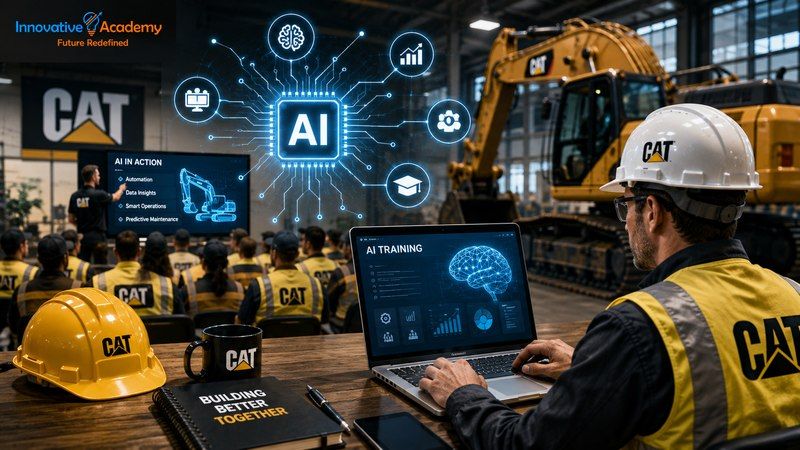

Caterpillar Is Spending $100M to Train 118,000 Employees on AI — Proof That Upskilling Is the New Job Security
Table of Contents
- What Caterpillar Actually Announced
- Why a Machinery Company Is Investing in AI Skills
- The Number Behind the Decision: 40% by 2030
- This Isn't Charity — It's Risk Management
- What This Signals for Every Industry, Not Just Manufacturing
- The Uncomfortable Truth About Waiting
- What Upskilling Actually Looks Like in Practice
- Where to Start — With Innovative Academy
- Final Thoughts
When a 100-year-old heavy machinery company — not a Silicon Valley startup — commits $100 million to retraining its entire workforce for an AI-driven future, it deserves attention.
Caterpillar's pledge isn't a marketing gesture. It's one of the clearest signals yet that job security in 2026 no longer comes from tenure or a fixed job title. It comes from how current your skills are.
Here's what Caterpillar actually announced, why it matters, and what it means if you're a working professional wondering whether upskilling is really worth the time investment.
1. What Caterpillar Actually Announced
Caterpillar has pledged $100 million over five years to retrain its global workforce — roughly 118,000 employees across 93 manufacturing facilities, including 37 in the United States — in robotics, automation, AI technologies, digital twins, and machine learning.
The company is calling it its first pledge of this kind, timed to coincide with its centennial year.
"This pledge, our first of its kind, reflects our dedication to collaborating with our global stakeholders to devise the best training solutions."
— Jaime Mineart, Caterpillar Chief Technology Officer
This sits alongside Caterpillar's existing STEM outreach programs and paid technician training initiatives — but at $100 million and 118,000 employees, it's a step change in scale, not an incremental addition.
2. Why a Machinery Company Is Investing in AI Skills
Caterpillar isn't an AI company. It builds bulldozers, mining trucks, and industrial engines.
That's precisely why this pledge is a stronger signal than a tech company doing the same thing.
AI adoption has moved well past the software industry and is now reshaping how physical, industrial work gets done, from autonomous mining fleets to AI-assisted equipment diagnostics.
If a century-old industrial manufacturer sees AI fluency as core to its next hundred years, that's a strong indicator of where every industry — not just tech — is heading.
3. The Number Behind the Decision: 40% by 2030
Caterpillar's own reasoning traces back to a widely cited World Economic Forum 2025 projection: approximately 40% of workers' existing skills will be transformed or become obsolete by 2030.
That's not a prediction about jobs disappearing — it's a prediction about the content of jobs changing faster than most companies' training programs are built to handle.
That 40% figure is the actual business case behind Caterpillar's $100 million pledge.
Retraining an existing workforce is usually cheaper and faster than replacing it — but only if the retraining starts early enough to keep up with how quickly the underlying skills are changing.
It's worth sitting with what "40% of skills transformed" actually means in practice, because it's easy to read past a percentage without absorbing what it implies.
It doesn't mean four in ten workers will lose their jobs. It means that for nearly every worker, a meaningful chunk of what they currently know how to do will look different — new tools, new interfaces, and new processes layered on top of or replacing the old ones — within a few years.
A technician who's spent a decade diagnosing equipment failures by ear and experience is now also expected to read the output of an AI-assisted diagnostic system and know when to trust it and when to override it.
The underlying expertise doesn't disappear; it gets asked to operate alongside a new layer of tooling, and someone has to teach that layer before it becomes a requirement rather than an option.
4. This Isn't Charity — It's Risk Management
It's important to understand why a public company spends nine figures on employee training: it's not primarily generosity.
A company the size of Caterpillar faces a real operational risk if a large share of its skilled workforce can't operate the automated, AI-assisted systems it's investing in elsewhere.
Retraining 118,000 people is Caterpillar's way of hedging against the risk that its transformation will outpace its people.
That reframing matters for how you should think about upskilling personally.
Companies aren't upskilling their workforces because it's a nice-to-have benefit — they're doing it because the alternative, a workforce that can't operate on the new systems, is an existential business risk.
The same logic applies to individual careers: skills that don't keep pace with how your industry actually operates become a personal risk, not just a company one.
5. What This Signals for Every Industry, Not Just Manufacturing
Caterpillar is a useful case study precisely because it's not a tech company.
If AI-related retraining is now a centennial-scale strategic priority in heavy machinery manufacturing, it's reasonable to assume the same pressure is building — often less visibly — in logistics, retail, finance, healthcare administration, and IT services across India.
The specific tools differ by industry, but the underlying shift is the same: the skills that got someone hired five years ago are not the skills that will keep them competitive five years from now.
6. The Uncomfortable Truth About Waiting
The risk with upskilling is that it rarely feels urgent until it's overdue.
Nobody gets a formal notice that their skills have become outdated — it shows up quietly, as being passed over for a project, a promotion, or a role that goes to someone with a more current skill set instead.
Caterpillar's employees aren't being asked to retrain because they've already fallen behind; they're being retrained proactively, before the gap becomes visible in performance reviews or layoffs.
That's the model worth copying at an individual level too — treating upskilling as routine maintenance, not emergency repair.
Consider two IT professionals with the same five years of experience in, say, systems administration.
One has spent those five years doing exactly what they were hired to do, well, without adding anything new to their skill set.
The other has spent the same five years adding a cloud certification, then some scripting and automation, then a security fundamentals course — none of it a dramatic pivot, just steady, incremental additions layered onto what they already knew.
On paper, both have "five years of experience." In an interview or an internal promotion review, they are not the same candidate at all.
The difference isn't talent or effort in their day job — it's whether they treated their skill set as something that needed periodic maintenance, the same way Caterpillar is now treating its workforce's skills as an asset that depreciates if it isn't actively renewed.
7. What Upskilling Actually Looks Like in Practice
For an individual professional, "upskilling" doesn't have to mean a full career pivot.
It typically means adding one adjacent, high-demand skill layer to what you already know:
- A developer learning cloud deployment and DevOps practices.
- A network administrator adding cloud security certifications.
- A systems administrator picking up Python for automation.
- An IT professional learning AI-assisted tools and automation workflows.
- A networking professional adding cloud and infrastructure skills.
The goal isn't to become a different kind of professional overnight. It's to make sure the skills sitting alongside your existing experience are the ones the market is actively paying for right now.
8. Where to Start — With Innovative Academy
Caterpillar's approach — structured, hands-on, industry-aligned training rather than ad hoc learning — is precisely the model followed by Innovative Academy for professionals and students looking to build relevant IT skills.
If you're not waiting for your employer to fund a $100 million retraining pledge, these are practical starting points:
- AWS DevOps Engineering Training and Azure Architecture Training — for professionals adding cloud skills to their existing IT backgrounds.
- DevOps Bootcamp — a structured path for professionals looking for a genuine skill pivot rather than a surface-level course.
- Linux Administration and CCNA — for infrastructure professionals modernizing skills that remain foundational to automation and AI-driven systems.
The programs are designed around practical, hands-on learning and real-world skills, making them relevant for professionals who want to strengthen their existing IT background rather than start completely from scratch.
Ready to upgrade your IT skills? Explore the Innovative Academy IT training programs and find a learning path that matches your career goals.
9. Final Thoughts
Caterpillar didn't spend $100 million because AI is trendy.
It spent it because a WEF projection that 40% of workforce skills will shift by 2030 was a risk it couldn't afford to ignore — and retraining its existing 118,000 employees was cheaper and faster than not doing so.
That same logic applies at the individual level.
Upskilling isn't a hedge against losing your job to AI directly. It's a hedge against becoming the person whose skills quietly stopped matching what their industry needs.
The most useful takeaway from Caterpillar's pledge isn't really about Caterpillar at all — it's the reminder that even the most stable-seeming, century-old industries are treating skills as a depreciating asset that requires ongoing investment, not a one-time purchase made in college or in your first job.
If a 100-year-old machinery company doesn't consider its current workforce "finished" in terms of training, it's worth asking whether you should consider yourself finished either.
The professionals who come out ahead over the next few years won't necessarily be the most naturally talented ones — they'll be the ones who treated their skill set the way Caterpillar is now treating its workforce: as something worth actively, continuously investing in, long before the gap becomes visible in a performance review or a layoff notice.
Don't Wait Until Your Skills Become Outdated
Build the cloud, networking, Linux, DevOps, and AI-ready skills needed for the changing IT industry.