
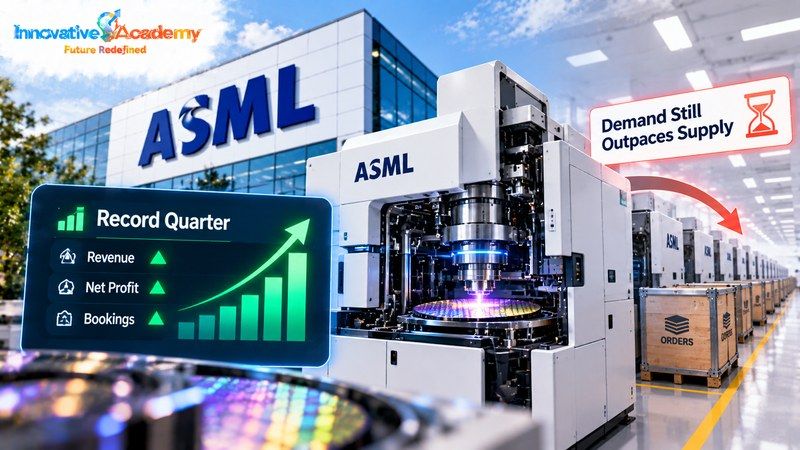

ASML Just Posted a Record Quarter — and Says It Still Can't Build Machines Fast Enough
1. Introduction
ASML, the Dutch company that makes the lithography machines TSMC, Samsung, and Intel all depend on to manufacture advanced chips, reported record third-quarter 2026 sales on October 14 and raised its own full-year guidance in the same release. The more interesting line in that announcement wasn't the record, it was CEO Christophe Fouquet saying the company's planned supply for 2027 and 2028 won't be enough to meet what customers are already asking for.
2. The Record Numbers From October 14
ASML's Q3 2026 total net sales came in at €11.7 billion (€11,662 million), which the company itself called a record, landing toward the high end of its own guidance range. Net income was €4.96 billion, with basic earnings per share of €12.95. Gross margin rose sharply to 57.5%, up from 54.0% in the prior quarter, helped by Installed Base Management sales, the servicing and upgrading of machines already in the field, coming in at €3.3 billion, above what the company had guided for. In the quarter, ASML sold 113 new lithography systems and 8 used ones, and bought back roughly €4.1 billion of its own shares under its 2026–2028 buyback program. An interim dividend of €1.88 per share is payable on November 4.
3. Guidance Went Up Again
ASML didn't just report a strong quarter, it raised what comes next. Fourth-quarter guidance calls for net sales of €14.2–15.2 billion and a gross margin around 57%. For the full year, ASML now expects 2026 net sales of €44–45 billion, up from its prior range of €43–45 billion, with full-year gross margin guidance raised to around 56% from 54–56%. Two consecutive guidance increases in one release, for both the immediate quarter and the full year, is a specific signal that management's confidence is building, not just holding steady.
4. The Real Story: Customers Want to Order Machines for 2029 and 2030
Here's the sentence worth reading twice. Fouquet said in the release: "Our customers continue to increase their short- and medium-term equipment demand forecasts with us," attributing that mainly to how customers now view the size and duration of AI-related investment. He went further: "some customers are expressing an interest in placing orders with us for 2029 and even 2030." That's not a company talking about this quarter or even next year, it's chipmakers trying to lock in lithography capacity roughly three to four years out, a planning horizon that only makes sense if those customers expect AI-driven chip demand to still be climbing well into the next decade.
5. Why "Not Enough Supply" Is a Different Problem Than "Not Enough Demand"
Most companies would treat rising demand forecasts as unambiguously good news. ASML's own words frame it as a genuine operational problem: "we now expect that our supply as currently planned for both 2027 and 2028 will not fully meet the demand of our customers." The company had already announced plans to increase capacity by roughly 30% by 2027 and 2028. Fouquet's statement says that increase, planned months ago, is no longer going to be enough, and ASML is now studying ways to add further capacity for 2028 specifically. In the meantime, the company is leaning on its productivity upgrade portfolio, essentially selling customers more output from the machines they already have installed, which is part of why Installed Base Management revenue beat its own guidance this quarter.
6. What Gets Left Out of a Preliminary Headline Like This One
It's fair to separate what this specific release actually confirms from what it only gestures toward. ASML did not report net bookings for the quarter, the figure that shows new orders actually signed rather than sales already recognized, nor did it break out revenue by region or by EUV versus other lithography systems. The capacity-shortfall statements come directly from the CEO's own remarks in the official release, not from an analyst's inference, which gives them more weight than a typical forecast. But "customers are expressing interest in placing orders" is also not the same claim as "orders for 2029 and 2030 have been signed." The demand signal is real and comes from the company itself, the exact scale of confirmed future orders isn't disclosed here.
7. Why One Dutch Company's Machines Matter to the Entire Chip Industry
ASML holds an effective monopoly on extreme ultraviolet lithography, the process required to manufacture the most advanced chips in the world, which means its capacity constraints don't stay contained to one company's balance sheet. If ASML genuinely cannot build enough machines to meet 2027 and 2028 demand, that ceiling applies to every chipmaker relying on its most advanced systems, regardless of how much capital those chipmakers are willing to spend on their own fabs. A shortage at this single point in the supply chain is a structurally different kind of constraint than ordinary demand growth, because no amount of customer spending fixes it faster than ASML can physically build and ship machines.
8. Building the Fundamentals at Innovative Academy
Innovative Academy's Hardware & Networking program in Bangalore covers the manufacturing and systems concepts behind stories like this one, how semiconductor equipment, fabrication capacity, and supply chains actually fit together, context that turns a single company's quarterly guidance into a readable signal about the entire chip industry rather than an isolated set of numbers.
9. FAQs
1. Did ASML's own demand outpace what the company can supply?
According to CEO Christophe Fouquet's own statement in the Q3 2026 release, yes for 2027 and 2028 specifically: planned supply for those years "will not fully meet the demand of our customers."
2. Is ASML raising prices because of this shortage?
The release doesn't mention pricing changes. It describes ASML studying ways to add manufacturing capacity for 2028 and offering existing customers productivity upgrades to get more output from machines already installed.
3. Have customers actually placed orders for 2029 and 2030?
Not confirmed as signed orders. Fouquet said "some customers are expressing an interest in placing orders," which is a demand signal rather than a confirmed bookings figure; the release doesn't disclose net bookings for the quarter.
4. Why does ASML's capacity matter if TSMC and Samsung are building their own new factories?
Because those factories still depend on ASML's lithography machines to produce the most advanced chips. Extra fab space without enough available lithography systems doesn't translate into extra advanced-chip output.
5. Did ASML raise its full-year guidance?
Yes, twice over in the same release: both Q4 2026 guidance and full-year 2026 net sales guidance were raised from the company's prior figures, alongside an increase in full-year gross margin guidance.
10. Final Thoughts
The headline number here, a record €11.7 billion quarter, is real and confirmed. The more consequential detail is buried a few paragraphs into the same release: the company that makes the machines nearly every advanced chip on earth depends on is telling its own customers that its planned supply through 2028 won't be enough. That's a different kind of AI-boom signal than a stock price move or an earnings beat, it's the equipment maker at the literal bottleneck of the industry saying the constraint is physical capacity, not customer appetite.
If you want to build the hardware fundamentals behind stories like this one, explore the Hardware & Networking Course in Bangalore at Innovative Academy. Contact for course details: 8447712333.