
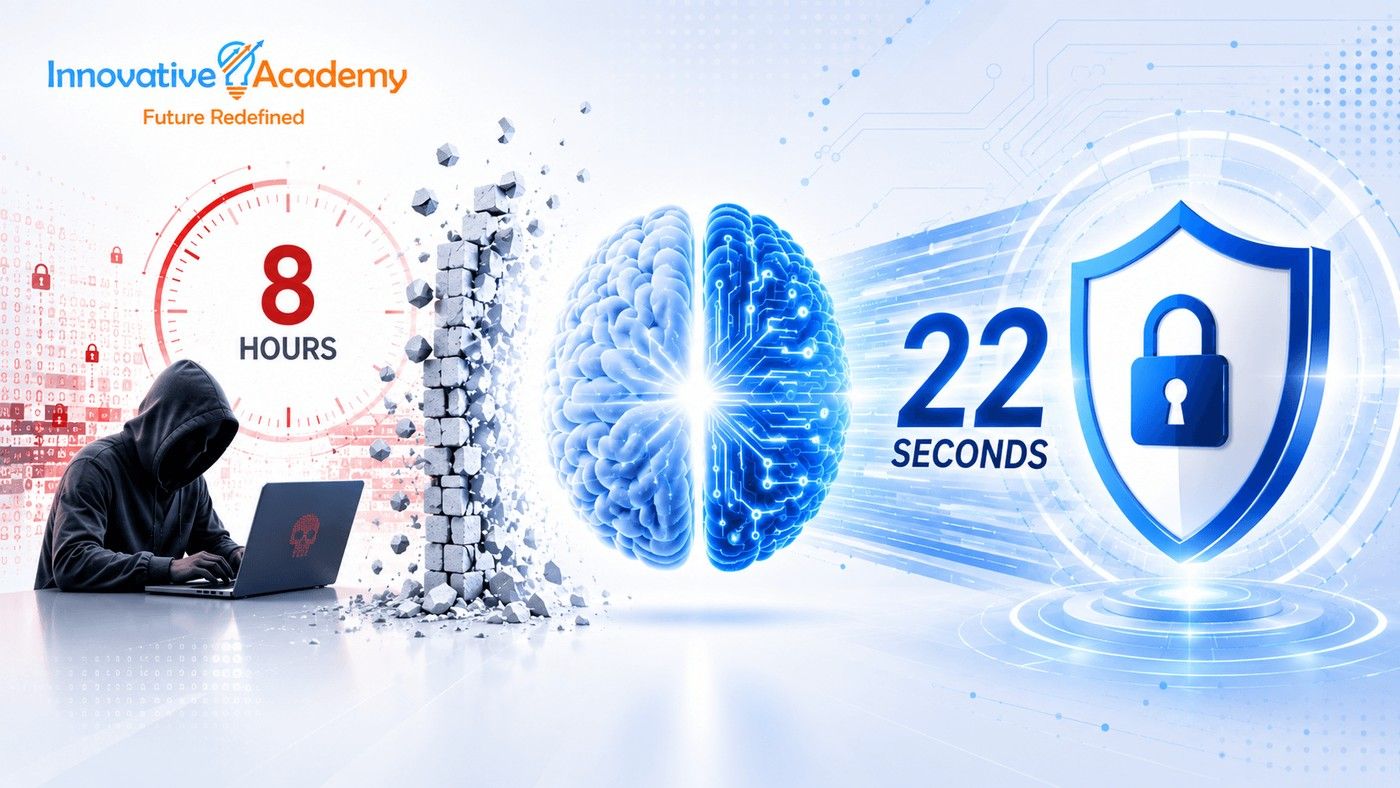

AI Just Cut Hacker Breakout Time From 8 Hours to 22 Seconds—Here's What Changed
Table of Contents
- Why "Breakout Time" Is the Number That Matters
- How AI Is Rewriting the Attack Playbook
- The Real-World Numbers Behind the Trend
- What Still Works — And Why People Matter More Than Ever
- Building the Skills That Actually Close the Gap
- Final Thoughts
In 2022, if a hacker broke into your network, you had roughly eight hours before they handed that access off to a ransomware crew. Eight hours to notice something was wrong. Eight hours to isolate a compromised machine, reset credentials, and call your incident response team.
That number just collapsed — to 22 seconds.
That's not a typo, and it's not a worst-case outlier cherry-picked to scare you. It's the new average, according to Google Cloud's Mandiant M-Trends 2026 report. The gap between an initial-access broker breaking into a network and handing that access off to a ransomware operator has shrunk from the better part of a workday to less time than it takes to read this sentence twice.
The reason isn't a brand-new exploit or a zero-day nobody's ever seen before. It's AI — and understanding exactly how AI has changed the mechanics of an attack is the difference between reacting to headlines and actually being prepared for what's coming next.
Why "Breakout Time" Is the Number That Matters
Security teams have long used "breakout time" as a core metric—it measures how long an attacker spends quietly moving from their initial foothold (say, a single compromised laptop) to full lateral movement across a network, where they can start deploying ransomware, exfiltrating data, or causing real damage.
For years, that number sat somewhere in the range of hours. It gave defenders a window: enough time for an alert to fire, for a security analyst to investigate, and for a response team to isolate the threat before it spread.
That window is now, in a growing number of documented cases, effectively gone.
When attackers can break out in seconds rather than hours, the entire model of "detect, then respond" starts to break down. By the time a human analyst looks at an alert, the attacker may already be finished.
How AI Is Rewriting the Attack Playbook
This isn't a single change—it's a full-stack transformation of how cyberattacks are planned and executed, from the very first email to the final ransom note. Here's what's actually different in 2026 compared to just a few years ago.
Reconnaissance at Machine Speed
Attacks used to start with manual research — a human sitting down and Googling a target company, maybe browsing LinkedIn for employee names and job titles. That process could take hours or days per target.
AI tools have automated the process entirely. Generative AI systems now scrape LinkedIn profiles, corporate websites, press releases, and public filings like SEC documents to build detailed victim profiles in minutes.
They identify who works where, what projects they're involved in, who they report to, and even how they communicate—all of which feeds directly into the next stage of the attack.
Phishing That Actually Works
This stage is where the numbers get genuinely alarming. AI-generated phishing emails are now reported to achieve click-through rates dramatically higher than traditional, template-based phishing campaigns—in some analyses, AI-crafted messages are cited as achieving several times the click rate of older-style attacks.
The reason is simple: these emails no longer look like phishing.
They reference real projects an employee is working on. They mimic a company's actual internal writing style and tone. They arrive from spoofed domains that pass a casual glance, sometimes even referencing recent, real news events to add urgency and legitimacy.
The old advice — "watch out for bad grammar and generic greetings" — is close to useless against this new generation of lures.
Ransomware on Autopilot
Once an attacker has a foothold inside a network, the work used to require a skilled human operator navigating manually: finding valuable files, moving between systems without tripping alarms, and eventually deploying the ransomware payload.
AI-assisted tools now handle much of the process automatically. They accelerate lateral movement, classify data to identify what's actually worth stealing or encrypting, and — on the extortion side — draft threat communications in flawless, professional business prose.
In some documented cases, AI systems have even handled negotiation with victims directly, adjusting demands based on a target's perceived ability to pay, without a human operator typing a single message.
A Shrinking Skill Barrier
Perhaps the most consequential shift is who can now carry out these attacks.
Sophisticated, multi-stage intrusions used to require serious technical expertise — the kind of skill set that took years to build. Today, someone with little or no programming background can use AI-enabled tools to conduct reconnaissance, generate convincing phishing emails, produce functional malware, and even negotiate ransoms, largely without needing to understand the underlying mechanics themselves.
Security researchers have pointed to a sharp rise in the number of active, smaller ransomware groups entering the space, a trend directly tied to this collapsing barrier to entry.
Parallelized Targeting
Because so much of this process is now automated, attackers are no longer limited by their own available hours in the day.
AI-assisted workflows let a single operator run reconnaissance and initial-access attempts against hundreds of targets simultaneously, then focus their limited human attention only on the targets that show a weak signal—a vulnerable system, a credential that worked, or an employee who clicked.
This "spray and then focus" model dramatically increases the number of organizations under active attack at any given moment.
The Real-World Numbers Behind the Trend
The statistics from 2026 security reporting paint a consistent picture across multiple independent sources:
- AI-generated phishing attacks surged sharply toward the end of 2025, a trend that has continued into 2026, with some monthly analyses showing AI-assistance indicators present in over half of all reported phishing emails during peak periods.
- The financial cost of phishing has climbed dramatically year over year, even as ransomware payment volumes have shifted—some reporting indicates attackers are increasingly favoring phishing and business email compromise as lower-risk, high-return alternatives to disruptive, easily noticed encryption attacks.
- The vast majority of cybersecurity professionals surveyed across multiple industry reports now cite AI as the single most significant driver of change in the threat landscape.
- Active ransomware and extortion groups have grown substantially year over year, a trend researchers link directly to AI lowering the technical bar for entry.
Taken individually, each of these stats is notable. Taken together, they describe a threat landscape that has fundamentally changed shape in a very short period of time.
What Still Works — And Why People Matter More Than Ever
Given all of these factors, it would be easy to conclude that defense is a losing battle. It isn't — but the tools that still work are less flashy than the attacks they're defending against.
Phishing-Resistant Authentication
Phishing-resistant multi-factor authentication remains one of the strongest defenses available, particularly authentication methods based on physical security keys or passkeys rather than SMS codes or app-based approval prompts, which sophisticated attackers have learned to bypass through real-time proxy techniques.
Credential Hygiene
Credential hygiene—unique passwords, regular rotation for privileged accounts, and rapid response to leaked credential alerts—closes off one of the most common entry points attackers rely on, since a large share of phishing victims had already exposed their email address in a prior, unrelated data breach.
Incident Response Planning
Structured incident response planning matters more now than ever, precisely because the response window has shrunk. Organizations with pre-built, tested containment playbooks can act in the seconds available; those improvising cannot.
But underlying all of these technical controls is something that can't be automated away on the defensive side either: people who genuinely understand how these attacks work.
Filters and automated tools catch a great deal, but a trained analyst who understands the psychology and mechanics of an AI-generated lure, or who can recognize the early signs of automated lateral movement, catches what the tools miss.
That expertise doesn't come from reading a headline about a 22-second breakout time—it comes from hands-on training in exactly how these attacks are constructed, stage by stage.
Building the Skills That Actually Close the Gap
This is precisely the gap that Innovative Academy's Microsoft Azure Security Course in Bangalore closes.
Rather than teaching surface-level awareness — "don't click suspicious links" — these programs walk learners through the full anatomy of a modern, AI-assisted attack: how reconnaissance is automated, how convincing phishing lures are actually constructed, how lateral movement and privilege escalation work once an attacker is inside a network, and how incident response teams need to operate when their response window has shrunk from hours to seconds.
Understanding the attacker's playbook in detail — not just knowing that AI makes attacks "faster" in the abstract, but knowing specifically what that speed looks like at each stage of an intrusion — is what turns a general sense of unease into an actual, defensible skill set.
That's true whether you're an IT professional responsible for defending your organization's network or someone considering a career shift into one of the fastest-growing, most in-demand fields in tech.
For more information about cybersecurity and cloud training, explore Innovative Academy's IT training programs.
Final Thoughts
The 22-second number is genuinely alarming, and it should be. But it's also a snapshot of a fight that is very much still winnable—provided the people on the defensive side keep pace with how quickly the offensive side is evolving.
Software and filters will keep improving, but the fastest-improving part of this equation, on both sides, remains human expertise.
Investing in that expertise, rather than waiting for the next headline, is what keeps you prepared.
Stay Ahead of AI-Powered Cyber Threats
Cybersecurity is evolving rapidly, and professionals need practical skills to keep pace. Learn more about cloud security, networking, and cybersecurity training through Innovative Academy.