
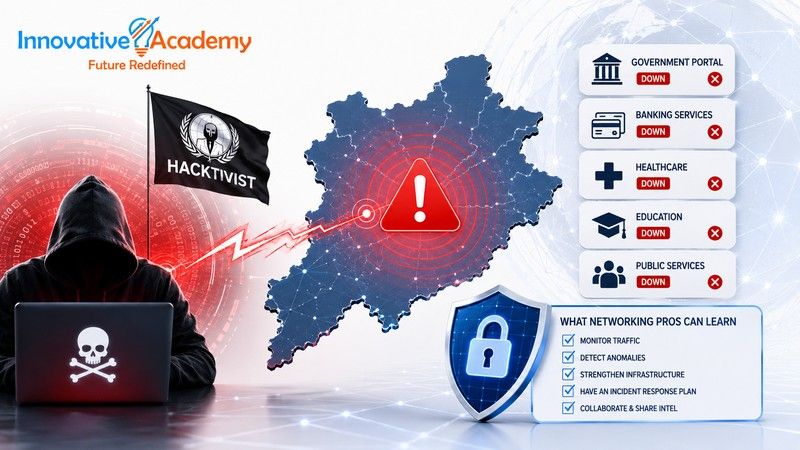

A Hacktivist Group Took Down a Country's Digital Services — What Networking Pros Can Learn From It
Table of Contents
- What Actually Happened in Norway
- Who Are Server Killers?
- How a DDoS Attack Actually Works
- What Was Affected—and What Wasn't
- Why Government Digital Infrastructure Keeps Getting Targeted
- How Organizations Actually Defend Against This
- What This Means If You're Building Networking or Security Skills
- Frequently Asked Questions
- Final Thoughts
Starting on the night of August 24, 2026, roughly ten digital services run by the Norwegian government slowed to a crawl or went offline entirely, including the national electronic ID systems ID-porten and MinID, the Altinn business portal, and digital postal services.
A pro-Russian hacking collective calling itself Server Killers claimed responsibility, tying the attack directly to a defense and security cooperation agreement Norway had just signed with Ukraine.
No data was breached. No systems were compromised in the sense of an intruder gaining access. What took a country's digital services offline for three days was something conceptually simple that every networking professional studies early in their career: a distributed denial-of-service attack.
That simplicity is precisely what makes this incident worth understanding in detail, rather than filing away as just another headline.
1. What Actually Happened in Norway
Norway's Digitalization Directorate (Digdir), the government body responsible for the country's shared digital infrastructure, confirmed that around ten services experienced disruption over roughly three days starting August 24.
The affected list reads like a country's essential digital plumbing: ID-porten and MinID, which citizens use to authenticate into virtually every government service; the Altinn portal, used heavily by businesses; and digital postal services, used for official correspondence.
Digdir was careful to draw a distinction that matters enormously in security communication: a DDoS attack disrupting availability is not the same as a breach compromising data.
Officials stated that core systems remained operational and that there was no evidence of personal data leakage. Norway's National Criminal Investigation Service (Kripos) opened an investigation, and the Police Security Service (PST) has been monitoring the situation.
As of the reporting available, there is no independent confirmation that Server Killers was actually behind the attack. Attribution in hacktivist-claimed incidents like this is often murkier than the initial claim suggests.
2. Who Are Server Killers?
Server Killers is a pro-Russian hacking collective that has been active since 2023, with a track record of targeting websites in Denmark, the United Kingdom, Romania, and Canada.
The group maintains ties to another well-known pro-Russian hacktivist organization, NoName057(16), which has run similar DDoS campaigns against countries perceived as supporting Ukraine.
Groups like Server Killers typically do not operate with the resources or sophistication of state intelligence services. Their attacks tend to be opportunistic and symbolic — timed to a political event and aimed at maximum visibility rather than deep, sustained compromise.
In this case, the attack was reportedly linked by the group to Norway and Ukraine signing a defense cooperation agreement shortly before the disruption began.
That does not make the disruption any less real for citizens and businesses who could not access government services for three days, but it does shape how seriously to weigh the "cyberwar" framing sometimes used in coverage.
3. How a DDoS Attack Actually Works
A distributed denial-of-service attack does not exploit a software flaw the way a vulnerability such as a code injection bug does — it does not need one.
Instead, it overwhelms a target with far more traffic or connection requests than its infrastructure can handle, so legitimate users simply cannot get through.
Think of it less like picking a lock and more like flooding a building's entrance with so many people that nobody, including the people who actually belong there, can get inside.
The "distributed" part matters. Rather than one attacking machine, which would be relatively easy to block, these attacks typically come from large numbers of compromised or rented devices spread across the internet, sending traffic simultaneously.
That distribution makes DDoS attacks difficult to block using a simple firewall rule. The traffic can come from many different sources and may sometimes resemble legitimate requests.
For networking professionals, this highlights why understanding traffic flows, bandwidth, connection limits, routing, load balancing, and network architecture is so important.
If you are building these fundamentals, you can explore the networking and cloud training programs at Innovative Academy.
4. What Was Affected — and What Wasn't
It is worth being precise about the blast radius here because "government digital services disrupted" can sound scarier than what actually happened.
Availability was affected. Citizens and businesses trying to log in, file something through Altinn, or access digital mail encountered slowdowns or outages.
Confidentiality and integrity were not affected according to the information available from officials. There was no confirmed evidence that data was stolen or altered, and no systems were confirmed to have been breached.
That distinction is precisely why the CIA triad — confidentiality, integrity, and availability — is one of the first concepts taught in serious networking and security training.
A DDoS attack is fundamentally an availability attack.
Understanding that distinction shapes the entire response. This incident called for capacity, traffic filtering, resilience, and availability measures rather than a response centered on evidence of data theft.
For learners building networking fundamentals, a structured CCNA training program in Bangalore can provide the foundation needed to understand routing, traffic behavior, network services, and infrastructure security.
5. Why Government Digital Infrastructure Keeps Getting Targeted
Government services make attractive targets for hacktivist groups for reasons that have little to do with technical vulnerability and everything to do with visibility and symbolism.
Taking down a private company's website may generate limited attention. Taking down systems citizens use to log into government services, pay taxes, or access official mail generates news coverage, public frustration, and political pressure.
The attack is also part of a broader pattern. Pro-Russian hacktivist groups have conducted similar DDoS campaigns against multiple countries providing support to Ukraine over the past several years.
Norway's incident therefore should not be viewed entirely in isolation. It fits into an ongoing pattern of politically motivated disruption in which government, public-sector, and critical digital infrastructure can become targets.
For networking and cybersecurity teams, the takeaway is straightforward: availability must be treated as a security requirement, not simply an infrastructure concern.
6. How Organizations Actually Defend Against This
Modern DDoS defense rests on several core techniques. Understanding these mechanisms is genuinely foundational networking knowledge rather than a niche specialty.
Traffic Scrubbing and Filtering
Specialized DDoS mitigation services and appliances analyze incoming traffic and attempt to filter malicious requests before they reach the actual application.
The goal is simple: remove attack traffic while allowing legitimate users to continue reaching the service.
Content Delivery Networks and Edge Distribution
Content delivery networks (CDNs) and distributed edge infrastructure can spread traffic across many geographically distributed servers.
This means an attacker has to overwhelm significantly more infrastructure instead of concentrating the entire attack against a single origin server.
Cloud platforms have made these capabilities increasingly accessible, which is why networking professionals should understand how traditional networking concepts connect with cloud infrastructure and security.
You can explore more cloud, networking, and security-focused training options to build these skills.
Rate Limiting and Anomaly Detection
Rate limiting places thresholds on how much traffic or how many requests a source can generate within a particular period.
Anomaly detection can identify patterns that appear automated or unusual compared with normal user behavior.
Neither technique is a universal solution, but both can reduce the impact of certain types of malicious traffic.
Redundancy and Capacity Planning
Simply having more capacity than an expected attack can buy valuable time.
Organizations can distribute services across multiple systems, network paths, data centers, availability zones, or points of presence to reduce the impact of a single bottleneck.
Incident Response and Communication Planning
Technical mitigation is only one part of handling a major availability incident.
Clear public communication can prevent unnecessary panic and misinformation while engineers work on mitigation. Digdir's statements distinguishing service disruption from a confirmed data breach demonstrate why accurate communication matters during a cyber incident.
7. What This Means If You're Building Networking or Security Skills
An incident like this is a genuinely useful case study precisely because it is conceptually simple.
There is no exotic zero-day here and no advanced persistent threat quietly living inside a network for months. Instead, there is a fundamental networking problem — overwhelming available capacity — executed against real infrastructure with real consequences.
That is precisely the kind of scenario covered in a solid networking and security foundation: understanding how traffic moves, where bottlenecks form, and how defenses such as rate limiting, filtering, load balancing, and redundancy are designed into networks.
It is also a reminder that security is not a separate discipline simply bolted onto networking. The two areas are deeply connected.
Anyone building toward a serious networking career benefits from treating attack scenarios like this as part of the core curriculum rather than an advanced elective.
Students interested in building these fundamentals can explore CCNA training in Bangalore and the wider IT networking and cloud courses available at Innovative Academy.
8. Frequently Asked Questions
Did the attackers actually breach Norway's systems?
No. Officials have described the incident as a disruption of availability caused by a DDoS attack, rather than a confirmed breach. There was no confirmed evidence of data being accessed, stolen, or altered.
Is it confirmed that Server Killers carried out the attack?
The group claimed responsibility and connected the attack to Norway's cooperation with Ukraine. However, based on the available reporting, there was no independent confirmation verifying the claim.
Why couldn't Norway just block the attack traffic immediately?
DDoS traffic can be distributed across large numbers of sources and may resemble legitimate traffic. This makes it much harder to deal with using a simple firewall block than a single malicious IP address.
Effective mitigation can require specialized traffic filtering, scrubbing infrastructure, rate limiting, scalable capacity, and distributed architecture.
Is this kind of attack becoming more common?
Politically motivated DDoS campaigns have been repeatedly used by pro-Russian hacktivist groups against countries supporting Ukraine. Norway's incident fits that broader pattern of politically motivated digital disruption.
9. Final Thoughts
There is something almost humbling about a country's essential digital services going offline because of an attack technique taught in introductory networking courses.
No zero-day. No elite tradecraft. Just enough traffic, aimed well, at infrastructure that mattered.
That simplicity is the lesson worth keeping.
Strong network defense is not only about stopping the most sophisticated attacks imaginable. It is about getting the fundamentals — capacity planning, traffic filtering, redundancy, rate limiting, monitoring, and clear incident communication — genuinely right.
For aspiring network engineers and cybersecurity professionals, incidents like this demonstrate why networking fundamentals remain essential even as infrastructure becomes increasingly cloud-based and automated.
Build the fundamentals first, understand how networks fail, and then learn how to design them so that failure is harder to achieve.
Explore more: Innovative Academy IT Training Programs | CCNA Training in Bangalore